

Pass Databricks-Certified-Professional-Data-Engineer Exam in First Attempt Guaranteed 2024 Dumps!
Databricks-Certified-Professional-Data-Engineer Dumps Full Questions - Exam Study Guide
Databricks Certified Professional Data Engineer exam is a rigorous certification exam that requires extensive knowledge and experience in data engineering. Candidates must have a deep understanding of data engineering concepts, such as data modeling, data warehousing, ETL, data governance, and data security. Additionally, they must have experience working with Databricks tools and technologies, such as Apache Spark, Delta Lake, and MLflow. Passing Databricks-Certified-Professional-Data-Engineer exam demonstrates that the candidate has the skills and knowledge needed to build and optimize data pipelines on the Databricks platform.
Databricks Certified Professional Data Engineer (Databricks-Certified-Professional-Data-Engineer) Exam is a certification exam designed to test the knowledge and skills of data engineers who use Databricks to build and manage data pipelines. Databricks is a cloud-based data processing and analytics platform that provides a unified workspace for data scientists, data engineers, and business analysts to collaborate and work with large-scale data. Databricks-Certified-Professional-Data-Engineer exam is intended for data engineers who have experience in developing and maintaining data pipelines using Databricks and are looking to validate their skills and knowledge.
Databricks Certified Professional Data Engineer exam is a challenging and rigorous exam that requires candidates to have a deep understanding of data engineering concepts and a strong knowledge of the Databricks platform. However, with the right preparation, candidates can pass the exam and achieve this valuable certification. Databricks offers various resources and training programs to help candidates prepare for the exam, including online courses, practice exams, and study guides.
NEW QUESTION # 40
Which of the following section in the UI can be used to manage permissions and grants to tables?
- A. Workspace admin settings
- B. Data Explorer
- C. Admin UI
- D. User access control lists
- E. User Settings
Answer: B
Explanation:
Explanation
The answer is Data Explorer
NEW QUESTION # 41
Which of the following python statements can be used to replace the schema name and table name in the query?
- A. 1.table_name = "sales"
2.query = "select * from {schema_name}.{table_name}" - B. 1.table_name = "sales"
2.schema_name = "bronze"
3.query = f"select * from schema_name.table_name" - C. 1.table_name = "sales"
2.query = f"select * from {schema_name}.{table_name}" - D. 1.table_name = "sales"
2.query = f"select * from + schema_name +"."+table_name"
Answer: C
Explanation:
Explanation
The answer is
1.table_name = "sales"
2.query = f"select * from {schema_name}.{table_name}"
It is always best to use f strings to replace python variables, rather than using string concatenation.
NEW QUESTION # 42
You are currently working to ingest millions of files that get uploaded to the cloud object storage for consumption, and you are asked to build a process to ingest this data, the schema of the file is expected to change over time, and the ingestion process should be able to handle these changes automatically. Which of the following method can be used to ingest the data incrementally?
- A. Checkpoint
- B. AUTO APPEND
- C. Structured Streaming
- D. COPY INTO
- E. AUTO LOADER
Answer: E
Explanation:
Explanation
The answer is AUTO LOADER,
Use Auto Loader instead of the COPY INTO SQL command when:
*You want to load data from a file location that contains files in the order of millions or higher. Auto Loader can discover files more efficiently than the COPY INTO SQL command and can split file processing into multiple batches.
*COPY INTO only directory listing but AUTO LOADER supports File notification method where the Auto Loader continues to ingest files as they arrive in cloud object storage lever-aging cloud provider(Queues and triggers) and Spark's structured streaming.
*Your data schema evolves frequently. Auto Loader provides better support for schema in-ference and evolution. See Configuring schema inference and evolution in Auto Loader.
NEW QUESTION # 43
A data engineer is testing a collection of mathematical functions, one of which calculates the area under a curve as described by another function.
Which kind of the test does the above line exemplify?
- A. Integration
- B. functional
- C. Manual
- D. Unit
Answer: D
Explanation:
A unit test is designed to verify the correctness of a small, isolated piece of code, typically a single function.
Testing a mathematical function that calculates the area under acurve is an example of a unit test because it is testing a specific, individual function to ensure it operates as expected.
References:
* Software Testing Fundamentals: Unit Testing
NEW QUESTION # 44
How VACCUM and OPTIMIZE commands can be used to manage the DELTA lake?
- A. VACCUM command can be used to delete empty/blank parquet files in a delta table. OPTIMIZE command can be used to update stale statistics on a delta table.
- B. OPTIMIZE command can be used to compact small parquet files, and the VAC-CUM command can be used to delete parquet files that are marked for deletion/unused.
(Correct) - C. VACCUM command can be used to compress the parquet files to reduce the size of the table, OPTIMIZE command can be used to cache frequently delta tables for better performance.
- D. VACCUM command can be used to compact small parquet files, and the OP-TIMZE command can be used to delete parquet files that are marked for dele-tion/unused.
- E. VACCUM command can be used to delete empty/blank parquet files in a delta table, OPTIMIZE command can be used to cache frequently delta tables for better perfor-mance.
Answer: B
Explanation:
Explanation
VACCUM:
You can remove files no longer referenced by a Delta table and are older than the retention thresh-old by running the vacuum command on the table. vacuum is not triggered automatically. The de-fault retention threshold for the files is 7 days. To change this behavior, see Configure data reten-tion for time travel.
OPTIMIZE:
Using OPTIMIZE you can compact data files on Delta Lake, this can improve the speed of read queries on the table. Too many small files can significantly degrade the performance of the query.
NEW QUESTION # 45
A data engineer has a Job with multiple tasks that runs nightly. One of the tasks unexpectedly fails during 10
percent of the runs.
Which of the following actions can the data engineer perform to ensure the Job completes each night while
minimizing compute costs?
- A. They can set up the Job to run multiple times ensuring that at least one will complete
- B. They can observe the task as it runs to try and determine why it is failing
- C. They can institute a retry policy for the task that periodically fails
- D. They can institute a retry policy for the entire Job
- E. They can utilize a Jobs cluster for each of the tasks in the Job
Answer: C
NEW QUESTION # 46
What is the best way to describe a data lakehouse compared to a data warehouse?
- A. A data lakehouse couples storage and compute for complete control.
- B. A data lakehouse enables both batch and streaming analytics.
- C. A data lakehouse captures snapshots of data for version control purposes.
- D. A data lakehouse utilizes proprietary storage formats for data.
- E. A data lakehouse provides a relational system of data management
Answer: B
Explanation:
Explanation
Anser is A data lakehouse enables both batch and streaming analytics.
A lakehouse has the following key features:
*Transaction support: In an enterprise lakehouse many data pipelines will often be reading and writing data concurrently. Support for ACID transactions ensures consistency as multi-ple parties concurrently read or write data, typically using SQL.
*Schema enforcement and governance: The Lakehouse should have a way to support schema enforcement and evolution, supporting DW schema architectures such as star/snowflake-schemas. The system should be able to reason about data integrity, and it should have robust governance and auditing mechanisms.
*BI support: Lakehouses enable using BI tools directly on the source data. This reduces staleness and improves recency, reduces latency, and lowers the cost of having to operationalize two copies of the data in both a data lake and a warehouse.
*Storage is decoupled from compute: In practice this means storage and compute use sepa-rate clusters, thus these systems are able to scale to many more concurrent users and larger data sizes. Some modern data warehouses also have this property.
*Openness: The storage formats they use are open and standardized, such as Parquet, and they provide an API so a variety of tools and engines, including machine learning and Py-thon/R libraries, can efficiently access the data directly.
*Support for diverse data types ranging from unstructured to structured data: The lakehouse can be used to store, refine, analyze, and access data types needed for many new data applications, including images, video, audio, semi-structured data, and text.
*Support for diverse workloads: including data science, machine learning, and SQL and analytics. Multiple tools might be needed to support all these workloads but they all rely on the same data repository.
*End-to-end streaming: Real-time reports are the norm in many enterprises. Support for streaming eliminates the need for separate systems dedicated to serving real-time data applications.
NEW QUESTION # 47
The data engineering team is migrating an enterprise system with thousands of tables and views into the Lakehouse. They plan to implement the target architecture using a series of bronze, silver, and gold tables.
Bronze tables will almost exclusively be used by production data engineering workloads, while silver tables will be used to support both data engineering and machine learning workloads. Gold tables will largely serve business intelligence and reporting purposes. While personal identifying information (PII) exists in all tiers of data, pseudonymization and anonymization rules are in place for all data at the silver and gold levels.
The organization is interested in reducing security concerns while maximizing the ability to collaborate across diverse teams.
Which statement exemplifies best practices for implementing this system?
- A. Storinq all production tables in a single database provides a unified view of all data assets available throughout the Lakehouse, simplifying discoverability by granting all users view privileges on this database.
- B. Isolating tables in separate databases based on data quality tiers allows for easy permissions management through database ACLs and allows physical separation of default storage locations for managed tables.
- C. Because all tables must live in the same storage containers used for the database they're created in, organizations should be prepared to create between dozens and thousands of databases depending on their data isolation requirements.
- D. Working in the default Databricks database provides the greatest security when working with managed tables, as these will be created in the DBFS root.
- E. Because databases on Databricks are merely a logical construct, choices around database organization do not impact security or discoverability in the Lakehouse.
Answer: B
Explanation:
This is the correct answer because it exemplifies best practices for implementing this system. By isolating tables in separate databases based on data quality tiers, such as bronze, silver, and gold, the data engineering team can achieve several benefits. First, they can easily manage permissions for different users and groups through database ACLs, which allow granting or revoking access to databases, tables, or views. Second, they can physically separate the default storage locations for managed tables in each database, which can improve performance and reduce costs. Third, they can provide a clear and consistent naming convention for the tables in each database, which can improve discoverability and usability. Verified References: [Databricks Certified Data Engineer Professional], under "Lakehouse" section; Databricks Documentation, under "Database object privileges" section.
NEW QUESTION # 48
A SQL Dashboard was built for the supply chain team to monitor the inventory and product orders, but all of the timestamps displayed on the dashboards are showing in UTC format, so they requested to change the time zone to the location of New York. How would you approach resolving this issue?
- A. Add SET Timezone = America/New_York on every of the SQL queries in the dashboard.
- B. Under SQL Admin Console, set the SQL configuration parameter time zone to Ameri-ca/New_York
- C. Change the timestamp on the delta tables to America/New_York format
- D. Change the spark configuration of SQL endpoint to format the timestamp to Ameri-ca/New_York
- E. Move the workspace from Central US zone to East US Zone
Answer: B
Explanation:
Explanation
The answer is, Under SQL Admin Console, set the SQL configuration parameter time zone to America/New_York Here are steps you can take this to configure, so the entire dashboard is changed without changing individual queries Configure SQL parameters To configure all warehouses with SQL parameters:
1.Click Settings at the bottom of the sidebar and select SQL Admin Console.
2.Click the SQL Warehouse Settings tab.
3.In the SQL Configuration Parameters textbox, specify one key-value pair per line. Sepa-rate the name of the parameter from its value using a space. For example, to ena-ble ANSI_MODE:
Graphical user interface, text, application Description automatically generated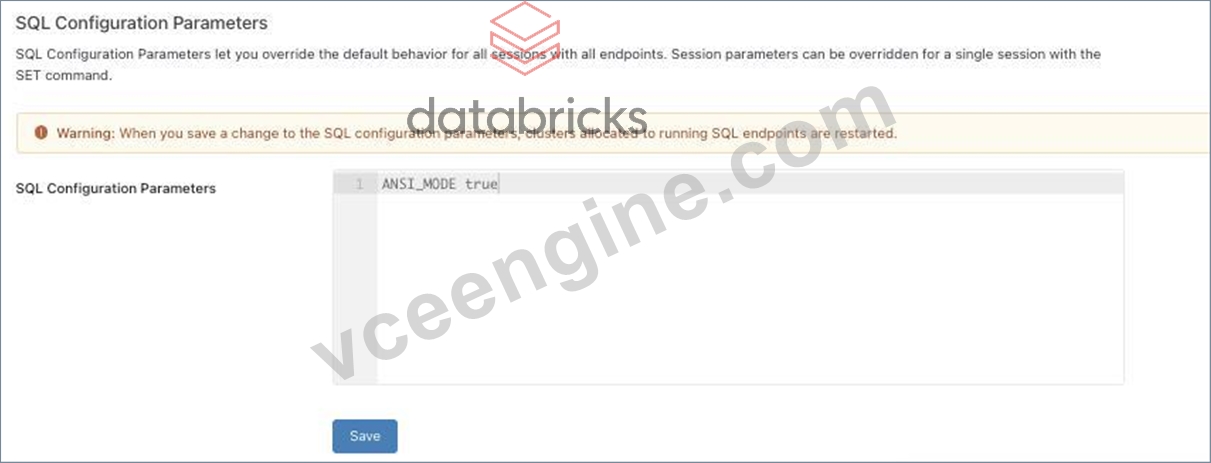
Similarly, we can add a line in the SQL Configuration parameters
timezone America/New_York
SQL configuration parameters | Databricks on AWS
NEW QUESTION # 49
A junior data engineer has ingested a JSON file into a table raw_table with the following schema:
1. cart_id STRING,
2. items ARRAY<item_id:STRING>
The junior data engineer would like to unnest the items column in raw_table to result in a new table with the
following schema:
1.cart_id STRING,
2.item_id STRING
Which of the following commands should the junior data engineer run to complete this task?
- A. 1. SELECT cart_id, reduce(items) AS item_id
2. FROM raw_table; - B. 1. SELECT cart_id, filter(items) AS item_id
2. FROM raw_table; - C. 1. SELECT cart_id, slice(items) AS item_id
2. FROM raw_table; - D. 1. SELECT cart_id, explode(items) AS item_id
2. FROM raw_table; - E. 1. SELECT cart_id, flatten(items) AS item_id
2. FROM raw_table;
Answer: D
NEW QUESTION # 50
One of the team members Steve who has the ability to create views, created a new view called re-gional_sales_vw on the existing table called sales which is owned by John, and the second team member Kevin who works with regional sales managers wanted to query the data in region-al_sales_vw, so Steve granted the permission to Kevin using command GRANT VIEW, USAGE ON regional_sales_vw to [email protected] but Kevin is still unable to access the view?
- A. Kevin is not the owner of the sales table
- B. Steve is not the owner of the sales table
- C. Kevin needs select access on the table sales
- D. Table access control is not enabled on the table and view
- E. Kevin needs owner access on the view regional_sales_vw
Answer: B
Explanation:
Explanation
Ownership determines whether or not you can grant privileges on derived objects to other users, since Steve is not the owner of the underlying sales table, he can not grant access to the table or data in the table indirectly.
Only owner(user or group) can grant access to a object
https://docs.microsoft.com/en-us/azure/databricks/security/access-control/table-acls/object-privileges#a-user-has Data object privileges - Azure Databricks | Microsoft Doc
NEW QUESTION # 51
Which statement describes the correct use of pyspark.sql.functions.broadcast?
- A. It caches a copy of the indicated table on attached storage volumes for all active clusters within a Databricks workspace.
- B. It marks a column as having low enough cardinality to properly map distinct values to available partitions, allowing a broadcast join.
- C. It marks a column as small enough to store in memory on all executors, allowing a broadcast join.
- D. It caches a copy of the indicated table on all nodes in the cluster for use in all future queries during the cluster lifetime.
- E. It marks a DataFrame as small enough to store in memory on all executors, allowing a broadcast join.
Answer: E
Explanation:
https://spark.apache.org/docs/3.1.3/api/python/reference/api/pyspark.sql.functions.broadcast.html The broadcast function in PySpark is used in the context of joins. When you mark a DataFrame with broadcast, Spark tries to send this DataFrame to all worker nodes so that it can be joined with another DataFrame without shuffling the larger DataFrame across the nodes. This is particularly beneficial when the DataFrame is small enough to fit into the memory of each node. It helps to optimize the join process by reducing the amount of data that needs to be shuffled across the cluster, which can be a very expensive operation in terms of computation and time.
Thepyspark.sql.functions.broadcastfunction in PySpark is used to hint to Spark that a DataFrame is small enough to be broadcast to all worker nodes in the cluster. When this hint is applied, Spark can perform a broadcast join, where the smaller DataFrame is sent to each executor only once and joined with the larger DataFrame on each executor. This can significantly reduce the amount of data shuffled across the network and can improve the performance of the join operation.
In a broadcast join, the entire smaller DataFrame is sent to each executor, not just a specific column or a cached version on attached storage. This function is particularly useful when one of the DataFrames in a join operation is much smaller than the other, and can fit comfortably in the memory of each executor node.
References:
* Databricks Documentation on Broadcast Joins: Databricks Broadcast Join Guide
* PySpark API Reference: pyspark.sql.functions.broadcast
NEW QUESTION # 52
When scheduling Structured Streaming jobs for production, which configuration automatically recovers from query failures and keeps costs low?
- A. Cluster: Existing All-Purpose Cluster;
Retries: Unlimited;
Maximum Concurrent Runs: 1 - B. Cluster: Existing All-Purpose Cluster;
Retries: None;
Maximum Concurrent Runs: 1 - C. Cluster: New Job Cluster;
Retries: None;
Maximum Concurrent Runs: 1 - D. Cluster: New Job Cluster;
Retries: Unlimited;
Maximum Concurrent Runs: Unlimited - E. Cluster: Existing All-Purpose Cluster;
Retries: Unlimited;
Maximum Concurrent Runs: 1
Answer: E
Explanation:
The configuration that automatically recovers from query failures and keeps costs low is to use a new job cluster, set retries to unlimited, and set maximum concurrent runs to 1. This configuration has the following advantages:
* A new job cluster is a cluster that is created and terminated for each job run. This means that the cluster resources are only used when the job is running, and no idle costs are incurred. This also ensures that the cluster is always in a clean state and has the latest configuration and libraries for the job1.
* Setting retries to unlimited means that the job will automatically restart the query in case of any failure, such as network issues, node failures, or transient errors. This improves the reliability and availability of the streaming job, and avoids data loss or inconsistency2.
* Setting maximum concurrent runs to 1 means that only one instance of the job can run at a time. This prevents multiple queries from competing for the same resources or writing to the same output location, which can cause performance degradation or data corruption3.
Therefore, this configuration is the best practice for scheduling Structured Streaming jobs for production, as it ensures that the job is resilient, efficient, and consistent.
References: Job clusters, Job retries, Maximum concurrent runs
NEW QUESTION # 53
You had AUTO LOADER to process millions of files a day and noticed slowness in load process, so you scaled up the Databricks cluster but realized the performance of the Auto loader is still not improving, what is the best way to resolve this.
- A. Merge files to one large file
- B. Setup a second AUTO LOADER process to process the data
- C. AUTO LOADER is not suitable to process millions of files a day
- D. Copy the data from cloud storage to local disk on the cluster for faster access
- E. Increase the maxFilesPerTrigger option to a sufficiently high number
Answer: E
Explanation:
Explanation
The default value of maxFilesPerTrigger is 1000 it can be increased to a much higher number but will require a much larger compute to process.
Graphical user interface, text, application, email Description automatically generated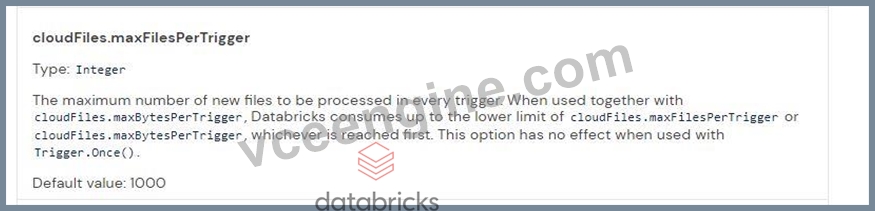
https://docs.databricks.com/ingestion/auto-loader/options.html
NEW QUESTION # 54
At the end of the inventory process a file gets uploaded to the cloud object storage, you are asked to build a process to ingest data which of the following method can be used to ingest the data incrementally, the schema of the file is expected to change overtime ingestion process should be able to handle these changes automatically. Below is the auto loader command to load the data, fill in the blanks for successful execution of the below code.
1.spark.readStream
2..format("cloudfiles")
3..option("cloudfiles.format","csv)
4..option("_______", 'dbfs:/location/checkpoint/')
5..load(data_source)
6..writeStream
7..option("_______",' dbfs:/location/checkpoint/')
8..option("mergeSchema", "true")
9..table(table_name))
- A. cloudfiles.schemalocation, checkpointlocation
- B. schemalocation, checkpointlocation
- C. checkpointlocation, schemalocation
- D. cloudfiles.schemalocation, cloudfiles.checkpointlocation
- E. checkpointlocation, cloudfiles.schemalocation
Answer: A
Explanation:
Explanation
The answer is cloudfiles.schemalocation, checkpointlocation
When reading the data cloudfiles.schemalocation is used to store the inferred schema of the incoming data.
When writing a stream to recover from failures checkpointlocation is used to store the offset of the byte that was most recently processed.
NEW QUESTION # 55
......
Databricks Certification Free Certification Exam Material from VCEEngine with 98 Questions: https://testking.vceengine.com/Databricks-Certified-Professional-Data-Engineer-vce-test-engine.html
