

Latest Feb-2024 AZ-220 Dumps PDF And Certification Training
Check your preparation for Microsoft AZ-220 On-Demand Exam
Microsoft AZ-220 Certification Exam is a great way for developers to demonstrate their expertise in Azure IoT services and stand out in the job market. Microsoft Azure IoT Developer certification exam is recognized globally and is a valuable asset for individuals who want to advance their careers in the field of IoT development. Candidates who pass the exam will receive a Microsoft Certified: Azure IoT Developer Specialty certification, which demonstrates their skills and knowledge in this area.
NEW QUESTION # 107
You need to use message enrichment to add additional device information to messages sent from the IoT gateway devices when the reported temperature exceeds a critical threshold.
How should you configure the enrich message values? To answer, select the appropriate options in the answer area.
NOTE: Each correct selection is worth one point.
Answer:
Explanation:
Explanation
Reference:
https://docs.microsoft.com/bs-cyrl-ba/azure/iot-hub/iot-hub-message-enrichments-overview
NEW QUESTION # 108
You have an Azure subscription that contains a resource group named RG1.
You need to deploy the Device Provisioning Service. The solution must ensure that the Device Provisioning Service can accept new device enrollments.
You create a Device Provisioning Service instance.
Which two actions should you perform next? Each correct answer presents part of the solution.
NOTE: Each correct selection is worth one point.
- A. From the Manage allocation policy blade of the Device Provisioning Service, configure an allocation policy.
- B. From the Certificates blade of the Device Provisioning Service, upload an X.509 certificate to the Device Provisioning Service.
- C. From the Azure portal, create a new Azure IoT hub.
- D. From the Linked IoT hubs blade of the Device Provisioning Service, link an Azure IoT hub.
Answer: B
Explanation:
Explanation
A: The Device Provisioning Service can only provision devices to IoT hubs that have been linked to it.
C: Allocation policy. The service-level setting that determines how Device Provisioning Service assigns devices to an IoT hub. There are three supported allocation policies:
Lowest latency: devices are provisioned to an IoT hub with the lowest latency to the device. Evenly weighted distribution Static configuration via the enrollment list Reference:
https://docs.microsoft.com/bs-latn-ba/azure/iot-dps/concepts-service
NEW QUESTION # 109
You have an Azure IoT Edge device.
You need to modify the credentials used to access the container registry.
What should you modify?
- A. the @edgeHub module twin
- B. the Azure IoT Hub device twin
- C. the IoT Edge module
- D. the $edgeAgent module twin
Answer: D
Explanation:
The module twin for the IoT Edge agent is called $edgeAgent and coordinates the communications between the IoT Edge agent running on a device and IoT Hub. The desired properties are set when applying a deployment manifest on a specific device as part of a single-device or at-scale deployment.
These properties include:
* runtime.settings.registryCredentials.{registryId}.username
* runtime.settings.registryCredentials.registryId}.password
Reference:
https://docs.microsoft.com/en-us/azure/iot-edge/module-edgeagent-edgehub
NEW QUESTION # 110
You are building an Azure loT solution that will include an Azure loT hub and will process environmental data for a multi-story building by using Azure Stream Analytics. The loT devices for the solution will provide the following data:
* Temperature
* Building
* Room
* Floor
You need to identify which data formats the loT devices can use to send the data as an array. What should you identify?
- A. Avro, JSON. and XML
- B. Avro and JSON only
- C. XML only
- D. JSON only OC.
- E. Avro only
Answer: D
NEW QUESTION # 111
You have an Azure IoT solution that contains an Azure loT hub and Azure 10T Edge devices.
You need to configure the metrics- collector module on the devices to send metrics to the loT hub as device-to-cloud messages.
Which environment variable should you update?
- A. MetricsEndpointsCSVc
- B. AllowedMetrics
- C. LogAnalyticsWorkspaceId
- D. UploadTarget
Answer: D
NEW QUESTION # 112
You have an Azure IoT solution that includes an Azure IoT hub.
You plan to deploy 10,000 IoT devices.
You need to validate the performance of the IoT solution while 10,000 concurrently connected devices stream telemetry. The solution must minimize effort.
What should you deploy?
- A. an Azure IoT Device Simulation from Azure IoT Solution Accelerator
- B. an Azure IoT Edge gateway configured as a protocol translation gateway
- C. Azure IoT Central application and a template for the retail industry
- D. an Azure function, an IoT Hub device SDK, and a timer trigger
Answer: A
Explanation:
The IoT solution accelerators are complete, ready-to-deploy IoT solutions that implement common IoT scenarios. The scenarios include connected factory and device simulation.
Use the Device Simulation solution accelerator to run simulated devices that generate realistic telemetry. You can use this solution accelerator to test the behavior of the other solution accelerators or to test your own custom IoT solutions.
Reference:
https://docs.microsoft.com/en-us/azure/iot-accelerators/about-iot-accelerators
Topic 1, ADatum
Requirements
Planned Changes
ADatum is developing an Azure IoT solution to monitor environmental conditions. The IoT solution consists of hardware devices and cloud services. All the devices will communicate directly to Azure IoT Hub.
The hardware devices will be deployed to the branch offices and will collect data about various environmental conditions such as temperature, humidity, air quality, and noise level. The devices will be wired by using Power over Ethernet (PoE) connections.
ADatum is developing the solution in the following three phases: proof of value (POV), pilot, and production.
Requirements. POV Requirements
The POV phase will demonstrate that a technical solution is viable. During this phase, 100 devices will be deployed to the main office and Azure Stream Analytics will be connected to an IoT hub to generate real-time alerts. Stream Analytics will perform the following processing:
Calculate the median rate of the telemetry across the entire devices that exceed the median rate by a factor of 4.
Compare the current telemetry to the specified thresholds and issue alerts when telemetry values are out of range.
Ensure that all message content during this phase is human readable to simplify debugging.
Requirements. Pilot Requirements
During the pilot phase, devices will be deployed to 10 offices. Each office will have up to 1,000 devices.
During this phase, you will add Azure Time Series Insights in parallel to Stream Analytics to support real-time graphs and queries in a dashboard web app.
The pilot deployment must minimize operating costs.
Requirements. Production Requirements
The production phase will include all the offices.
The production deployment will have one IoT hub in each Azure region. Devices must connect to the IoT hub in their region.
The production phase must meet the following requirements:
Ensure that the IoT solution can support performance and scale targets.
Ensure that the IoT solution support up to 1,000 devices per office.
Minimize operating costs of the IoT solution.
Requirements. Technical Requirements
Datum identifies the following requirements for the planned IoT solution:
The solution must generate real-time alerts when a fire condition is detected in an office. All the devices in that office must trigger an audible alarm siren within 10 seconds of the alert.
A dashboard UI must display alerts and the system status in real time and must allow device operators to make adjustments to the system.
Each device will send hourly updates to IoT Hub. Condition alerts will be sent immediately.
Multiple types of devices will collect telemetry that has different schemas.
IoT Hub must perform message routing based on the message body.
Direct methods must be used for cloud-to-device communication.
Reports must be provided monthly, quarterly, and annually.
Stored data queries must be as efficient as possible.
The device message size will be under 4 KB.
Development effort must be minimized.
Requirements. Throttle and Quotas
The relevant throttles and quotas for various IoT Hub tiers are shown in the following table.
Requirements. IoT Hub Routing
You plan to implement IoT Hub routing during the POV phase as shown in the following exhibit.
NEW QUESTION # 113
You are creating an Azure Digital Twins Query.
You need to return all the digital twins that have a contains relationship with a digital twin that has an ID of twin1.
How should you complete the query? To answer, select the appropriate options m the answer area NOTE: Each correct selection is worth one point.
Answer:
Explanation:
NEW QUESTION # 114
You have an Azure IoT hub.
You plan to deploy 1,000 IoT devices by using automatic device management.
The device twin is shown below.
You need to configure automatic device management for the deployment.
Which target Condition and Device Twin Path should you use? To answer, select the appropriate options in the answer area.
NOTE: Each correct selection is worth one point.
Answer:
Explanation:
Explanation:
Box 1: tags.engine.warpDriveType='VM105a'
Use tags to target twins. Before you create a configuration, you must specify which devices or modules you want to affect. Azure IoT Hub identifies devices and using tags in the device twin, and identifies modules using tags in the module twin.
Box 2: properties.desired.warpOperating
The twin path, which is the path to the JSON section within the twin desired properties that will be set.
For example, you could set the twin path to properties.desired.chiller-water and then provide the following JSON content:
{
"temperature": 66,
"pressure": 28
}
Reference:
https://docs.microsoft.com/en-us/azure/iot-hub/iot-hub-automatic-device-management
NEW QUESTION # 115
You have an Azure Stream Analytics job that connects to an Azure IoT hub named Hub1445 as a streaming data source. Hub1445 is configured as shown in the exhibit. (Click the Exhibit tab.)
The Stream Analytics job fails to receive any messages from the IoT hub.
What should you do to resolve the issue?
- A. Disable the Route2 route.
- B. Enable the fallback route.
- C. Change the Route1 route query to true.
- D. Enable the Route3 route.
Answer: C
Explanation:
The device telemetry is usually passed as JSON from the device through the IoT Hub - this is handled nicely by Azure Streaming Analytics queries.
The IoT Hub message routing should be configured as follows:
Data source: Device Telemetry Messages
Routing query: true (as the routing query is an expression that evaluates to true or false for each received message, the simplest way to send all messages to the endpoint is to just supply true as the query).
Reference:
https://darenmay.com/blog/azure-iot-streaming-analytics-data-lake-analytics-and-json/
NEW QUESTION # 116
Note: This question is part of a series of questions that present the same scenario. Each question in the series contains a unique solution that might meet the stated goals. Some question sets might have more than one correct solution, while others might not have a correct solution.
After you answer a question in this section, you will NOT be able to return to it. As a result, these questions will not appear in the review screen.
You have 20 IoT devices deployed across two floors of a building. The devices on the first floor must be set to 60 degrees. The devices on the second floor must be set to 80 degrees.
The device twins are configured to use a tag that identifies the floor on which the twins are located.
You create the following automatic configuration for the devices on the first floor.
You create the following automatic configuration for the devices on the second floor.
The IoT devices on the first floor report that the temperature is set to 80 degrees.
You need to ensure that the first-floor devices are set to the correct temperature.
Solution: In the automatic configuration for the second-floor devices, you set targetCondition to "tags.floor='second'".
Does this meet the goal?
- A. Yes
- B. No
Answer: A
Explanation:
Reference:
https://docs.microsoft.com/en-us/azure/iot-edge/module-deployment-monitoring?view=iotedge-2020-11
https://docs.microsoft.com/en-us/azure/iot-hub/iot-hub-automatic-device-management-cli
NEW QUESTION # 117
You have an Azure IoT hub.
You plan to attach three types of IoT devices as shown in the following table.
You need to select the appropriate communication protocol for each device.
What should you select? To answer, drag the appropriate protocols to the correct devices. Each protocol may be used once, more than once, or not at all. You may need to drag the split bar between panes or scroll to view content.
NOTE: Each correct selection is worth one point.
Answer:
Explanation:
Reference:
https://docs.microsoft.com/en-us/azure/iot-hub/iot-hub-devguide-protocols
NEW QUESTION # 118
You have an Azure IoT Central application that has a custom device template.
You need to configure the device template to support the following activities:
Return the reported power consumption.
Configure the desired fan speed.
Run the device reset routine.
Read the fan serial number.
Which option should you use for each activity? Each correct answer presents part of the solution.
NOTE: Each correct selection is worth one point.
Answer:
Explanation:
Explanation:
Box 1: Measurement
Telemetry/measurement is a stream of values sent from the device, typically from a sensor. For example, a sensor might report the ambient temperature.
Box 2: Property
The template can provide a writeable fan speed property
Properties represent point-in-time values. For example, a device can use a property to report the target temperature it's trying to reach. You can set writeable properties from IoT Central.
Box 3: Settings
Box 4: Command
You can call device commands from IoT Central. Commands optionally pass parameters to the device and receive a response from the device. For example, you can call a command to reboot a device in 10 seconds.
Reference:
https://docs.microsoft.com/en-us/azure/iot-central/core/howto-set-up-template
NEW QUESTION # 119
You have an Azure IoT hub that is being taken from prototype to production.
You plan to connect IoT devices to the IoT hub. The devices have hardware security modules (HSMs). You need to use the most secure authentication method between the devices and the IoT hub. Company policy prohibits the use of internally generated certificates.
Which authentication method should you use?
- A. a symmetric key
- B. An X.509 certificate signed by a root certification authority (CA).
- C. an X.509 self-signed certificate
- D. a certificate thumbprint
Answer: B
Explanation:
Explanation
Purchase X.509 certificates from a root certificate authority (CA). This method is recommended for production environments.
The hardware security module, or HSM, is used for secure, hardware-based storage of device secrets, and is the most secure form of secret storage. Both X.509 certificates and SAS tokens can be stored in the HSM Reference:
https://docs.microsoft.com/en-us/azure/iot-dps/concepts-security
NEW QUESTION # 120
You have an Azure IoT Edge automatic deployment named D1 that deploys a temperature module to five IoT Edge devices.
D1 has a deployment priority of 10 and the following module configuration.
You need to create a new layered deployment that will add a new twin property named ReportingMode. The new deployment must not overwrite the existing module configurations set by D1.
How should you configure the deployment? To answer, select the appropriate options in the answer area.
NOTE: Each correct selection is worth one point.
Answer:
Explanation:
Reference:
https://docs.microsoft.com/en-us/azure/iot-edge/module-deployment-monitoring
NEW QUESTION # 121
You have an Azure subscription that contains an Azure IoT hub and 100 IoT devices.
The devices connect to the IoT hub by using the Message Queuing Telemetry Transport (MQTT) protocol and authenticate to the IoT hub by using symmetric keys You need to configure the username and password for the MQTT connection.
What should you use? To answer, drag the appropriate components to the correct targets. Each component may be used once more than once or not at all. You may need to drag the split bar between panes or scroll to view content.
NOTE: Each correct selection is worth one point.
Answer:
Explanation:
Explanation
NEW QUESTION # 122
You have an Azure loT solution that includes an loT device named Device1.
You are creating an loT Plug and Play model for Device1.
On Device1, you create a device model file in a folder named dtmi/com/source/.
How should you complete the model? To answer select the appropriate options in the answer area.
NOTE: Each correct selection is worth one point.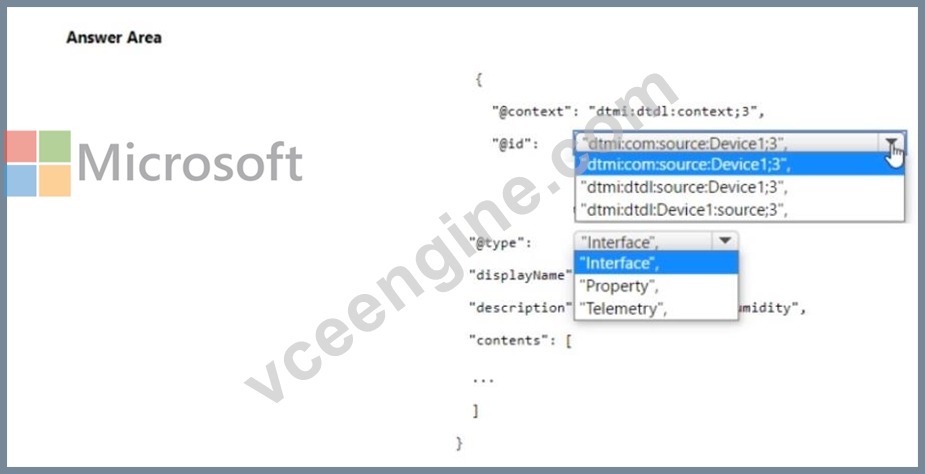
Answer:
Explanation:
NEW QUESTION # 123
Note: This question is part of a series of questions that present the same scenario. Each question in the series contains a unique solution that might meet the stated goals. Some question sets might have more than one correct solution, while others might not have a correct solution.
After you answer a question in this section, you will NOT be able to return to it. As a result, these questions will not appear in the review screen.
You have an Azure Stream Analytics job that receives input from an Azure IoT hub and sends the outputs to Azure Blob storage. The job has compatibility level 1.1 and six streaming units.
You have the following query for the job.
You plan to increase the streaming unit count to 12.
You need to optimize the job to take advantage of the additional streaming units and increase the throughput.
Solution: You change the query to the following.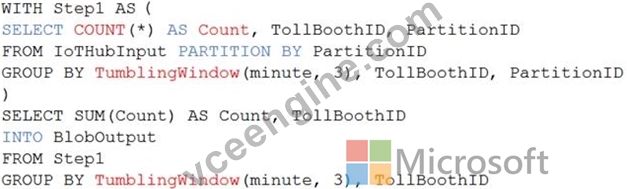
Does this meet the goal?
- A. Yes
- B. No
Answer: A
Explanation:
Explanation
Max number of Streaming Units with one step and with no partitions is 6.
Reference:
https://docs.microsoft.com/en-us/azure/stream-analytics/stream-analytics-parallelization
NEW QUESTION # 124
You have an Azure loT solution that uses Azure Digital Twins. You plan to ingest telemetry from an loT device into a digital twin.
You need to create an Azure function that will process the telemetry messages received by the Azure loT hub and update the digital twin of the loT device with the new values.
How should you complete the code? To answer, select the appropriate options in the answer area.
NOTE: Each correct selection is worth one point.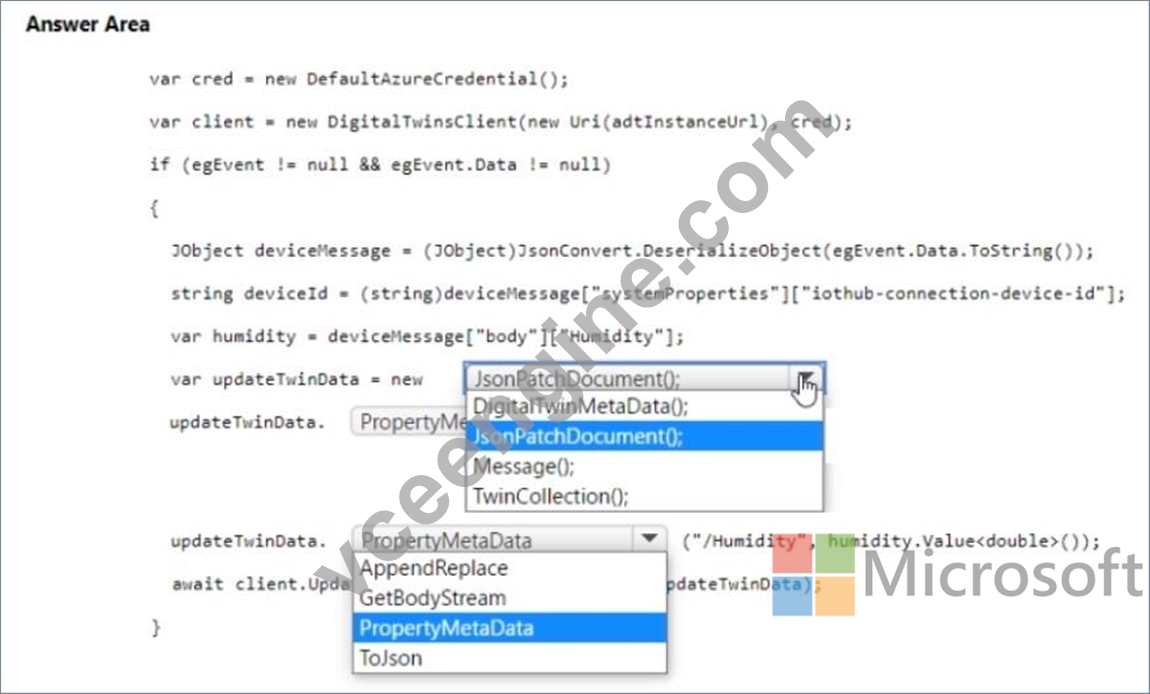
Answer:
Explanation:
NEW QUESTION # 125
You have an Azure subscription that contains an Azure IoT hub and 100 IoT devices.
The devices connect to the IoT hub by using the Advanced Message Queuing Protocol (AMQP) protocol and authenticate to the IoT hub by using symmetric keys.
You need to configure the SASL PLAIN username for the AMQP connection.
How should you configure the username? To answer, drag the appropriate options to the correct targets. Each option may be used once, more than once, or not at all. You may need to drag the split bar between panes or scroll to view content.
NOTE: Each correct selection is worth one point.
Answer:
Explanation:
Explanation
Table Description automatically generated with medium confidence
Box 1: DeviceID
If you use AMQP claims-based-security, the standard specifies how to transmit these tokens.
For SASL PLAIN, the username can be:
{policyName}@sas.root.{iothubName} if using IoT hub-level tokens.
{deviceId}@sas.{iothubname} if using device-scoped tokens.
Box 2: sas
Box 3:IoT hub hame
Reference:
https://docs.microsoft.com/en-us/azure/iot-hub/iot-hub-dev-guide-sas
NEW QUESTION # 126
DRAG DROP
You need to install the Azure IoT Edge runtime on a new device that runs Windows 10 IoT Enterprise.
Which four actions should you perform in sequence? To answer, move the appropriate actions from the list of actions to the answer area and arrange them in the correct order.
Select and Place: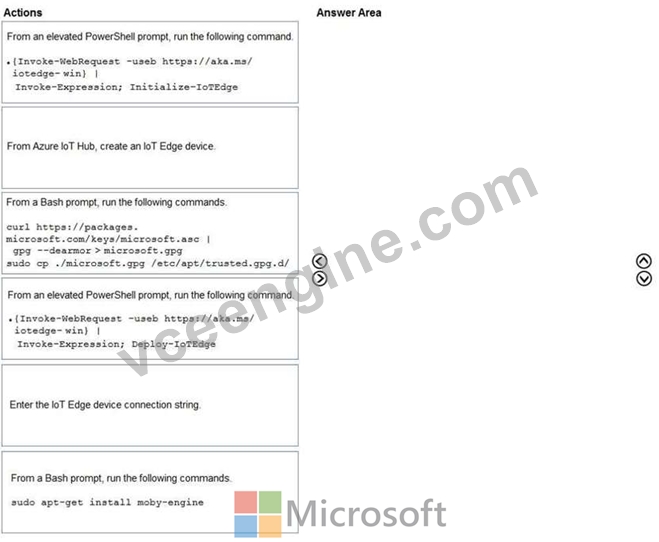
Answer:
Explanation:
Explanation:
Step 1: From Azure IoT Hub, create an IoT Edge Device
Step 2: Deploy-IoTEdge
The Deploy-IoTEdge command checks that your Windows machine is on a supported version, turns on the containers feature, and then downloads the moby runtime and the IoT Edge runtime. The command defaults to using Windows containers.
{Invoke-WebRequest -useb https://aka.ms/iotedge-win} | Invoke-Expression; ` Deploy-IoTEdge Step 3: Initialize-IoTEdge The Initialize-IoTEdge command configures the IoT Edge runtime on your machine. The command defaults to manual provisioning with Windows containers.
{Invoke-WebRequest -useb https://aka.ms/iotedge
Step 4: Enter the IoT Edge device connection string.
When prompted, provide the device connection string that you retrieved in step 1. The device connection string associates the physical device with a device ID in IoT Hub.
Reference:
https://docs.microsoft.com/en-us/azure/iot-edge/module-composition
NEW QUESTION # 127
You are prototyping an loT edge solution.
You are creating a deployment manifest for an loT edge device that will connect to an Azure loT hub. Which two modules should you include in the manifest? Each correct answer presents part of the solution. NOTE: Each correct selection is worth one point.
HA.
- A. zureiotsecurity
- B. edgeHub
- C. edgeAgent
- D. iotedgeModbus
- E. opc-publisher
Answer: A,B
NEW QUESTION # 128
......
Valid AZ-220 Dumps for Helping Passing Microsoft Exam: https://testking.vceengine.com/AZ-220-vce-test-engine.html
