

Download the Latest SCS-C02 Dumps - 2023 SCS-C02 Exam Questions
Latest Amazon SCS-C02 Certification Practice Test Questions
NEW QUESTION # 19
A company is using IAM Secrets Manager to store secrets for its production Amazon RDS database. The Security Officer has asked that secrets be rotated every 3 months. Which solution would allow the company to securely rotate the secrets? (Select TWO.)
- A. Place the RDS instance in a private subnet and an IAM Lambda function outside the VPC. Configure the private subnet to use an internet gateway. Schedule the Lambda function to run every 3 months lo rotate the secrets.
- B. Place the RDS instance in a private subnet and an IAM Lambda function inside the VPC in the private subnet. Configure a Secrets Manager interface endpoint. Schedule the Lambda function to run every 3 months to rotate the secrets.
- C. Place the RDS instance in a public subnet and an IAM Lambda function outside the VPC. Schedule the Lambda function to run every 3 months to rotate the secrets.
- D. Place the RDS instance in a private subnet and an IAM Lambda function inside the VPC in the private subnet. Schedule the Lambda function to run quarterly to rotate the secrets.
- E. Place the RDS instance in a private subnet and an IAM Lambda function inside the VPC in the private subnet. Configure the private subnet to use a NAT gateway. Schedule the Lambda function to run every
3 months to rotate the secrets.
Answer: B,E
NEW QUESTION # 20
A large corporation is creating a multi-account strategy and needs to determine how its employees should access the IAM infrastructure.
Which of the following solutions would provide the MOST scalable solution?
- A. Create dedicated IAM users within each IAM account that employees can assume through federation based upon group membership in their existing identity provider
- B. Configure the IAM Security Token Service to use Kerberos tokens so that users can use their existing corporate user names and passwords to access IAM resources directly
- C. Configure the IAM trust policies within each account's role to set up a trust back to the corporation's existing identity provider allowing users to assume the role based off their SAML token
- D. Use a centralized account with IAM roles that employees can assume through federation with their existing identity provider Use cross-account roles to allow the federated users to assume their target role in the resource accounts.
Answer: D
NEW QUESTION # 21
Your company is planning on using bastion hosts for administering the servers in IAM. Which of the following is the best description of a bastion host from a security perspective?
Please select:
- A. A Bastion host sits on the outside of an internal network and is used as a gateway into the private network and is considered the critical strong point of the network
- B. A Bastion host should be on a private subnet and never a public subnet due to security concerns
- C. A Bastion host should maintain extremely tight security and monitoring as it is available to the public
- D. Bastion hosts allow users to log in using RDP or SSH and use that session to S5H into internal network to access private subnet resources.
Answer: D
Explanation:
A bastion host is a special purpose computer on a network specifically designed and configured to withstand attacks. The computer generally hosts a single application, for example a proxy server, and all other services are removed or limited to reduce the threat to the computer.
In IAM, A bastion host is kept on a public subnet. Users log on to the bastion host via SSH or RDP and then use that session to manage other hosts in the private subnets.
Options A and B are invalid because the bastion host needs to sit on the public network. Option D is invalid because bastion hosts are not used for monitoring For more information on bastion hosts, just browse to the below URL:
https://docsIAM.amazon.com/quickstart/latest/linux-bastion/architecture.htl The correct answer is: Bastion hosts allow users to log in using RDP or SSH and use that session to SSH into internal network to access private subnet resources.
Submit your Feedback/Queries to our Experts
NEW QUESTION # 22
An IAM user receives an Access Denied message when the user attempts to access objects in an Amazon S3 bucket. The user and the S3 bucket are in the same AWS account. The S3 bucket is configured to use server-side encryption with AWS KMS keys (SSE-KMS) to encrypt all of its objects at rest by using a customer managed key from the same AWS account. The S3 bucket has no bucket policy defined. The IAM user has been granted permissions through an IAM policy that allows the kms:Decrypt permission to the customer managed key. The IAM policy also allows the s3:List* and s3:Get* permissions for the S3 bucket and its objects.
Which of the following is a possible reason that the IAM user cannot access the objects in the S3 bucket?
- A. The S3 bucket has been changed to use the AWS managed key to encrypt objects at rest.
- B. The IAM policy needs to allow the kms:DescribeKey permission.
- C. The KMS key policy has been edited to remove the ability for the AWS account to have full access to the key.
- D. An S3 bucket policy needs to be added to allow the IAM user to access the objects.
Answer: C
Explanation:
Explanation
The possible reason that the IAM user cannot access the objects in the S3 bucket is D. The KMS key policy has been edited to remove the ability for the AWS account to have full access to the key.
This answer is correct because the KMS key policy is the primary way to control access to the KMS key, and it must explicitly allow the AWS account to have full access to the key. If the KMS key policy has been edited to remove this permission, then the IAM policy that grants kms:Decrypt permission to the IAM user has no effect, and the IAM user cannot decrypt the objects in the S3 bucket12.
The other options are incorrect because:
A: The IAM policy does not need to allow the kms:DescribeKey permission, because this permission is not required for decrypting objects in S3 using SSE-KMS. The kms:DescribeKey permission allows getting information about a KMS key, such as its creation date, description, and key state3.
B: The S3 bucket has not been changed to use the AWS managed key to encrypt objects at rest, because this would not cause an Access Denied message for the IAM user. The AWS managed key is a default KMS key that is created and managed by AWS for each AWS account and Region. The IAM user does not need any permissions on this key to use it for SSE-KMS4.
C: An S3 bucket policy does not need to be added to allow the IAM user to access the objects, because the IAM user already has s3:List* and s3:Get* permissions for the S3 bucket and its objects through an IAM policy. An S3 bucket policy is an optional way to grant cross-account access or public access to an S3 bucket5.
References:
1: Key policies in AWS KMS 2: Using server-side encryption with AWS KMS keys (SSE-KMS) 3: AWS KMS API Permissions Reference 4: Using server-side encryption with Amazon S3 managed keys (SSE-S3) 5:
Bucket policy examples
NEW QUESTION # 23
A Development team has built an experimental environment to test a simple stale web application It has built an isolated VPC with a private and a public subnet. The public subnet holds only an Application Load Balancer a NAT gateway, and an internet gateway. The private subnet holds ail of the Amazon EC2 instances There are 3 different types of servers Each server type has its own Security Group that limits access lo only required connectivity. The Security Groups nave both inbound and outbound rules applied Each subnet has both inbound and outbound network ACls applied to limit access to only required connectivity Which of the following should the team check if a server cannot establish an outbound connection to the internet? (Select THREE.)
- A. The outbound network ACL rules on the private subnet and the Inbound network ACL rules on the public subnet
- B. That the 0.0.0./0 route in the private subnet route table points to the internet gateway in the public subnet
- C. The Security Group applied to the Application Load Balancer and NAT gateway
- D. The rules on any host-based firewall that may be applied on the Amazon EC2 instances
- E. The outbound network ACL rules on the private subnet and both the inbound and outbound rules on the public subnet
- F. The route tables and the outbound rules on the appropriate private subnet security group
Answer: B,C,E
Explanation:
because these are the factors that could affect the outbound connection to the internet from a server in a private subnet. The outbound network ACL rules on the private subnet and both the inbound and outbound rules on the public subnet must allow the traffic to pass through8. The security group applied to the application load balancer and NAT gateway must also allow the traffic from the private subnet9. The 0.0.0.0/0 route in the private subnet route table must point to the NAT gateway in the public subnet, not the internet gateway10. The other options are either irrelevant or incorrect for troubleshooting the outbound connection issue.
NEW QUESTION # 24
A company needs a security engineer to implement a scalable solution for multi-account authentication and authorization. The solution should not introduce additional user-managed architectural components. Native IAM features should be used as much as possible The security engineer has set up IAM Organizations w1th all features activated and IAM SSO enabled.
Which additional steps should the security engineer take to complete the task?
- A. Use an IAM SSO default directory to create users and groups for all employees that require access to IAM accounts. Link IAM SSO groups to the IAM users present in all accounts to inherit existing permissions. Instruct employees to access IAM accounts by using the IAM SSO user portal.
- B. Use an IAM SSO default directory to create users and groups for all employees that require access to IAM accounts. Assign groups to IAM accounts and link to permission sets in accordance with the employees'job functions and access requirements. Instruct employees to access IAM accounts by using the IAM SSO user portal.
- C. Use IAM Directory Service tor Microsoft Active Directory to create users and groups for all employees that require access to IAM accounts Enable IAM Management Console access in the created directory and specify IAM SSO as a source cl information tor integrated accounts and permission sets. Instruct employees to access IAM accounts by using the IAM Directory Service user portal.
- D. Use AD Connector to create users and groups for all employees that require access to IAM accounts.
Assign AD Connector groups to IAM accounts and link to the IAM roles in accordance with the employees'job functions and access requirements Instruct employees to access IAM accounts by using the IAM Directory Service user portal.
Answer: B
NEW QUESTION # 25
What are the MOST secure ways to protect the AWS account root user of a recently opened AWS account? (Select TWO.)
- A. Use AWS KMS to encrypt all AWS account root user and AWS IAM access keys and set automatic rotation to 30 days.
- B. Enable multi-factor authentication for the AWS account root user.
- C. Enable multi-factor authentication for the AWS IAM users with the Adminis-tratorAccess managed policy attached to them.
- D. Use the AWS account root user access keys instead of the AWS Management Console.
- E. Do not create access keys for the AWS account root user; instead, create AWS IAM users.
Answer: B,E
NEW QUESTION # 26
A company uses an Amazon S3 bucket to store reports Management has mandated that all new objects stored in this bucket must be encrypted at rest using server-side encryption with a client-specified IAM Key Management Service (IAM KMS) CMK owned by the same account as the S3 bucket. The IAM account number is 111122223333, and the bucket name Is report bucket. The company's security specialist must write the S3 bucket policy to ensure the mandate can be Implemented Which statement should the security specialist include in the policy?
- A.

- B.

- C.

- D.

Answer: C
NEW QUESTION # 27
Your company has just set up a new central server in a VPC. There is a requirement for other teams who have their servers located in different VPC's in the same region to connect to the central server. Which of the below options is best suited to achieve this requirement.
Please select:
- A. None of the above options will work.
- B. Set up VPC peering between the central server VPC and each of the teams VPCs.
- C. Set up an IPSec Tunnel between the central server VPC and each of the teams VPCs.
- D. Set up IAM DirectConnect between the central server VPC and each of the teams VPCs.
Answer: B
Explanation:
Explanation
A VPC peering connection is a networking connection between two VPCs that enables you to route traffic between them using private IPv4 addresses or IPv6 addresses. Instances in either VPC can communicate with each other as if they are within the same network. You can create a VPC peering connection between your own VPCs, or with a VPC in another IAM account within a single region.
Options B and C are invalid because you need to use VPC Peering
Option D is invalid because VPC Peering is available
For more information on VPC Peering please see the below Link:
http://docs.IAM.amazon.com/AmazonVPC/latest/UserGuide/vpc-peering.html
The correct answer is: Set up VPC peering between the central server VPC and each of the teams VPCs.
Submit your Feedback/Queries to our Experts
NEW QUESTION # 28
To meet regulatory requirements, a Security Engineer needs to implement an IAM policy that restricts the use of AWS services to the us-east-1 Region.
What policy should the Engineer implement?
- A.

- B.

- C.

- D.

Answer: C
Explanation:
https://docs.aws.amazon.com/IAM/latest/UserGuide/reference_policies_examples_aws_deny-requested-region.html
NEW QUESTION # 29
A company is designing a multi-account structure for its development teams. The company is using AWS Organizations and AWS Single Sign-On (AWS SSO). The company must implement a solution so that the development teams can use only specific AWS Regions and so that each AWS account allows access to only specific AWS services.
Which solution will meet these requirements with the LEAST operational overhead?
- A. Use AWS SSO to set up service-linked roles with IAM policy statements that include the Condition, Resource, and NotAction elements to allow access to only the Regions and services that are needed.
- B. Deactivate AWS Security Token Service (AWS STS) in Regions that the developers are not allowed to use.
- C. For each AWS account, create tailored identity-based policies for AWS SSO. Use statements that include the Condition, Resource, and NotAction elements to allow access to only the Regions and services that are needed.
- D. Create SCPs that include the Condition, Resource, and NotAction elements to allow access to only the Regions and services that are needed.
Answer: D
NEW QUESTION # 30
A systems engineer deployed containers from several custom-built images that an application team provided through a QA workflow The systems engineer used Amazon Elastic Container Service (Amazon ECS) with the Fargate launch type as the target platform The system engineer now needs to collect logs from all containers into an existing Amazon CloudWatch log group Which solution will meet this requirement?
- A. Download and configure the CloudWatch agent on the container instances
- B. Turn on the awslogs log driver by specifying parameters for awslogs-group and awslogs-region m the LogConfiguration property
- C. Configure an 1AM policy that includes the togs CreateLogGroup action Assign the policy to the container instances
- D. Set up Fluent Bit and FluentO as a DaemonSet to send logs to Amazon CloudWatch Logs
Answer: B
Explanation:
Explanation
The AWS documentation states that you can use the awslogs log driver to send log information to CloudWatch Logs. To use this method, you specify the parameters for awslogs-group and awslogs-region in the LogConfiguration property of the container definition. This method is the easiest way to send logs to CloudWatch Logs.
References: : Amazon Elastic Container Service Developer Guide
NEW QUESTION # 31
During a manual review of system logs from an Amazon Linux EC2 instance, a Security Engineer noticed that there are sudo commands that were never properly alerted or reported on the Amazon CloudWatch Logs agent Why were there no alerts on the sudo commands?
- A. The VPC requires that all traffic go through a proxy, and the CloudWatch Logs agent does not support a proxy configuration.
- B. There is a security group blocking outbound port 80 traffic that is preventing the agent from sending the logs
- C. The IAM instance profile on the EC2 instance was not properly configured to allow the CloudWatch Logs agent to push the logs to CloudWatch
- D. CloudWatch Logs status is set to ON versus SECURE, which prevents it from pulling in OS security event logs
Answer: C
NEW QUESTION # 32
A company's on-premises networks are connected to VPCs using an IAM Direct Connect gateway. The company's on-premises application needs to stream data using an existing Amazon Kinesis Data Firehose delivery stream. The company's security policy requires that data be encrypted in transit using a private network.
How should the company meet these requirements?
- A. Create a VPC endpoint tor Kinesis Data Firehose. Configure the application to connect to the VPC endpoint.
- B. Configure an IAM policy to restrict access to Kinesis Data Firehose using a source IP condition.
Configure the application to connect to the existing Firehose delivery stream. - C. Create a new TLS certificate in IAM Certificate Manager (ACM). Create a public-facing Network Load Balancer (NLB) and select the newly created TLS certificate. Configure the NLB to forward all traffic to Kinesis Data Firehose. Configure the application to connect to the NLB.
- D. Peer the on-premises network with the Kinesis Data Firehose VPC using Direct Connect. Configure the application to connect to the existing Firehose delivery stream.
Answer: A
Explanation:
Explanation
To stream data using an existing Amazon Kinesis Data Firehose delivery stream and encrypt it in transit using a private network, the company should do the following:
Create a VPC endpoint for Kinesis Data Firehose. This allows the company to use a private connection between their VPC and Kinesis Data Firehose without requiring an internet gateway or NAT device.
Configure the application to connect to the VPC endpoint. This allows the application to stream data using Kinesis Data Firehose over AWS PrivateLink, which encrypts all traffic with TLS.
NEW QUESTION # 33
A security engineer is defining the controls required to protect the IAM account root user credentials in an IAM Organizations hierarchy. The controls should also limit the impact in case these credentials have been compromised.
Which combination of controls should the security engineer propose? (Select THREE.) A)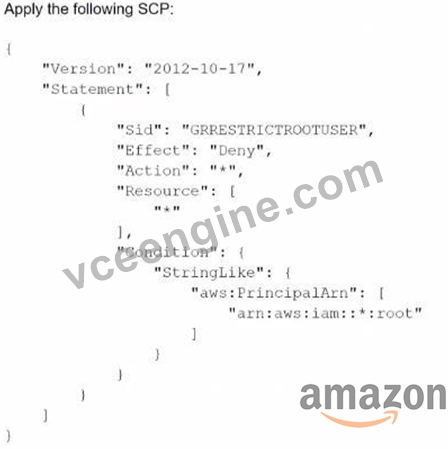
B)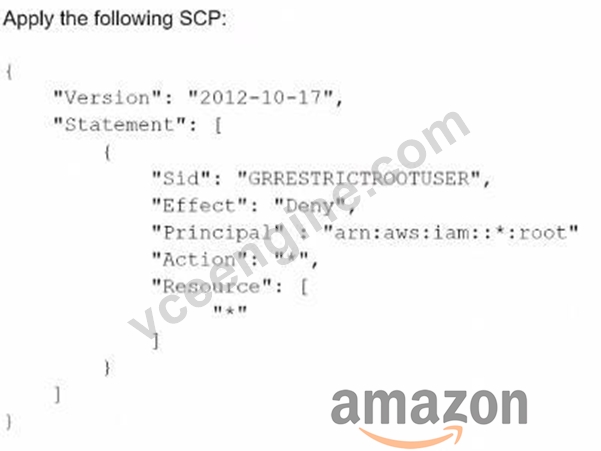
C) Enable multi-factor authentication (MFA) for the root user.
D) Set a strong randomized password and store it in a secure location.
E) Create an access key ID and secret access key, and store them in a secure location.
F) Apply the following permissions boundary to the toot user:
- A. Option D
- B. Option F
- C. Option E
- D. Option C
- E. Option B
- F. Option A
Answer: C,D,F
NEW QUESTION # 34
A company has several workloads running on AWS. Employees are required to authenticate using on-premises ADFS and SSO to access the AWS Management Console. Developers migrated an existing legacy web application to an Amazon EC2 instance. Employees need to access this application from anywhere on the internet, but currently, there is no authentication system built into the application.
How should the Security Engineer implement employee-only access to this system without changing the application?
- A. Implement AWS SSO in the master account and link it to ADFS as an identity provider. Define the EC2 instance as a managed resource, then apply an IAM policy on the resource.
- B. Place the application behind an Application Load Balancer (ALB). Use Amazon Cognito as authentication for the ALB. Define a SAML-based Amazon Cognito user pool and connect it to ADFS.
- C. Create an AWS Lambda custom authorizer as the authenticator for a reverse proxy on Amazon EC2.Ensure the security group on Amazon EC2 only allows access from the Lambda function.
- D. Define an Amazon Cognito identity pool, then install the connector on the Active Directory server. Use the Amazon Cognito SDK on the application instance to authenticate the employees using their Active Directory user names and passwords.
Answer: B
Explanation:
Explanation
https://docs.aws.amazon.com/elasticloadbalancing/latest/application/listener-authenticate-users.html
NEW QUESTION # 35
A company uses AWS Organizations to manage a small number of AWS accounts. However, the company plans to add 1 000 more accounts soon. The company allows only a centralized security team to create IAM roles for all AWS accounts and teams. Application teams submit requests for IAM roles to the security team.
The security team has a backlog of IAM role requests and cannot review and provision the IAM roles quickly.
The security team must create a process that will allow application teams to provision their own IAM roles.
The process must also limit the scope of IAM roles and prevent privilege escalation.
Which solution will meet these requirements with the LEAST operational overhead?
- A. Create an SCP and a permissions boundary for IAM roles. Add the SCP to the root OU so that only roles that have the permissions boundary attached can create any new IAM roles.
- B. Create an IAM group for each application team. Associate policies with each IAM group. Provision IAM users for each application team member. Add the new IAM users to the appropriate IAM group by using role-based access control (RBAC).
- C. Delegate application team leads to provision IAM rotes for each team. Conduct a quarterly review of the IAM rotes the team leads have provisioned. Ensure that the application team leads have the appropriate training to review IAM roles.
- D. Put each AWS account in its own OU. Add an SCP to each OU to grant access to only the AWS services that the teams plan to use. Include conditions tn the AWS account of each team.
Answer: A
Explanation:
Explanation
To create a process that will allow application teams to provision their own IAM roles, while limiting the scope of IAM roles and preventing privilege escalation, the following steps are required:
Create a service control policy (SCP) that defines the maximum permissions that can be granted to any IAM role in the organization. An SCP is a type of policy that you can use with AWS Organizations to manage permissions for all accounts in your organization. SCPs restrict permissions for entities in member accounts, including each AWS account root user, IAM users, and roles. For more information, see Service control policies overview.
Create a permissions boundary for IAM roles that matches the SCP. A permissions boundary is an advanced feature for using a managed policy to set the maximum permissions that an identity-based policy can grant to an IAM entity. A permissions boundary allows an entity to perform only the actions that are allowed by both its identity-based policies and its permissions boundaries. For more information, see Permissions boundaries for IAM entities.
Add the SCP to the root organizational unit (OU) so that it applies to all accounts in the organization.
This will ensure that no IAM role can exceed the permissions defined by the SCP, regardless of how it is created or modified.
Instruct the application teams to attach the permissions boundary to any IAM role they create. This will prevent them from creating IAM roles that can escalate their own privileges or access resources they are not authorized to access.
This solution will meet the requirements with the least operational overhead, as it leverages AWS Organizations and IAM features to delegate and limit IAM role creation without requiring manual reviews or approvals.
The other options are incorrect because they either do not allow application teams to provision their own IAM roles (A), do not limit the scope of IAM roles or prevent privilege escalation (B), or do not take advantage of managed services whenever possible .
Verified References:
https://docs.aws.amazon.com/organizations/latest/userguide/orgs_manage_policies_scp.html
https://docs.aws.amazon.com/IAM/latest/UserGuide/access_policies_boundaries.html
NEW QUESTION # 36
A company deployed IAM Organizations to help manage its increasing number of IAM accounts. A security engineer wants to ensure only principals in the Organization structure can access a specic Amazon S3 bucket.
The solution must also minimize operational overhead
Which solution will meet these requirements?
- A. Have the account creation trigger an IAM Lambda function that manages the bucket policy, allowing access to accounts listed in the policy only.
- B. Add an SCP to the Organizations master account, allowing all principals access to the bucket.
- C. 1 Put all users into an IAM group with an access policy granting access to the J bucket.
- D. Specify the organization ID in the global key condition element of a bucket policy, allowing all principals access.
Answer: D
NEW QUESTION # 37
A developer 15 building a serverless application hosted on IAM that uses Amazon Redshift in a data store.
The application has separate modules for read/write and read-only functionality. The modules need their own database users tor compliance reasons.
Which combination of steps should a security engineer implement to grant appropriate access' (Select TWO )
- A. Configure an IAM policy for each module Specify the ARN of an IAM user that allows the GetClusterCredentials API call
- B. Create focal database users for each module
- C. Configure a VPC endpoint for Amazon Redshift Configure an endpoint policy that maps database users to each application module, and allow access to the tables that are required for read-only and read/write
- D. Configure an IAM poky for each module Specify the ARN of an Amazon Redshift database user that allows the GetClusterCredentials API call
- E. Configure cluster security groups for each application module to control access to database users that are required for read-only and read/write.
Answer: B,D
Explanation:
Explanation
To grant appropriate access to the application modules, the security engineer should do the following:
Configure an IAM policy for each module. Specify the ARN of an Amazon Redshift database user that allows the GetClusterCredentials API call. This allows the application modules to use temporary credentials to access the database with the permissions of the specified user.
Create local database users for each module. This allows the security engineer to create separate users for read/write and read-only functionality, and to assign them different privileges on the database tables.
NEW QUESTION # 38
A company wants to monitor the deletion of AWS Key Management Service (AWS KMS) customer managed keys. A security engineer needs to create an alarm that will notify the company before a KMS key is deleted.
The security engineer has configured the integration of AWS CloudTrail with Amazon CloudWatch.
What should the security engineer do next to meet these requirements?
- A. Create an Amazon EventBridge rule to detect KMS API calls of DeleteAlias. Create an AWS Lambda function to send an Amazon Simple Notification Service (Amazon SNS) message to the company. Add the Lambda function as the target of the EventBridge rule.
- B. Specify the deletion time of the key material during KMS key creation. Create a custom AWS Config rule to assess the key's scheduled deletion. Configure the rule to trigger upon a configuration change. Send a message to an Amazon Simple Notification Service (Amazon SNS) topic if the key is scheduled for deletion.
- C. Create an Amazon EventBridge rule to detect KMS API calls of DisableKey and ScheduleKeyDeletion.
Create an AWS Lambda function to send an Amazon Simple Notification Service (Amazon SNS) message to the company. Add the Lambda function as the target of the EventBridge rule. - D. Create an Amazon Simple Notification Service (Amazon SNS) policy to detect KMS API calls of RevokeGrant and ScheduleKeyDeletion.Create an AWS Lambda function to generate the alarm and send the notification to the company. Add the Lambda function as the target of the SNS policy.
Answer: C
Explanation:
Explanation
The AWS documentation states that you can create an Amazon EventBridge rule to detect KMS API calls of DisableKey and ScheduleKeyDeletion. You can then create an AWS Lambda function to send an Amazon Simple Notification Service (Amazon SNS) message to the company. You can add the Lambda function as the target of the EventBridge rule. This method will meet the requirements.
References: : AWS KMS Developer Guide
NEW QUESTION # 39
A company wants to deploy a distributed web application on a fleet of EC2 instances. The fleet will be fronted by a Classic Load Balancer that will be configured to terminate the TLS connection The company wants to make sure that all past and current TLS traffic to the Classic Load Balancer stays secure even if the certificate private key is leaked.
To ensure the company meets these requirements, a Security Engineer can configure a Classic Load Balancer with:
- A. An HTTPS listener that uses a custom security policy that allows only perfect forward secrecy cipher suites
- B. An HTTPS listener that uses a certificate that is managed by Amazon Certification Manager.
- C. A TCP listener that uses a custom security policy that allows only perfect forward secrecy cipher suites.
- D. An HTTPS listener that uses the latest IAM predefined ELBSecuntyPolicy-TLS-1 -2-2017-01 security policy
Answer: A
Explanation:
this is a way to configure a Classic Load Balancer with perfect forward secrecy cipher suites. Perfect forward secrecy is a property of encryption protocols that ensures that past and current TLS traffic stays secure even if the certificate private key is leaked. Cipher suites are sets of algorithms that determine how encryption is performed. A custom security policy is a set of cipher suites and protocols that you can select for your load balancer to support. An HTTPS listener is a process that checks for connection requests using encrypted SSL/TLS protocol. By using an HTTPS listener that uses a custom security policy that allows only perfect forward secrecy cipher suites, you can ensure that your Classic Load Balancer meets the requirements. The other options are either invalid or insufficient for configuring a Classic Load Balancer with perfect forward secrecy cipher suites.
NEW QUESTION # 40
A company's security engineer wants to receive an email alert whenever Amazon GuardDuty, AWS Identity and Access Management Access Analyzer, or Amazon Made generate a high-severity security finding. The company uses AWS Control Tower to govern all of its accounts. The company also uses AWS Security Hub with all of the AWS service integrations turned on.
Which solution will meet these requirements with the LEAST operational overhead?
- A. Host an application on Amazon EC2 to call the GuardDuty, 1AM Access Analyzer, and Macie APIs. Within the application, use the Amazon Simple Notification Service (Amazon SNS) API to retrieve high-severity findings and to send the findings to an SNS topic. Subscribe the desired email addresses to the SNS topic.
- B. Create an Amazon EventBridge rule with a pattern that matches AWS Control Tower events with high severity. Configure the rule to send the findings to a target Amazon Simple Notification Service (Amazon SNS) topic. Subscribe the desired email addresses to the SNS topic.
- C. Create an Amazon EventBridge rule with a pattern that matches Security Hub findings events with high severity. Configure the rule to send the findings to a target Amazon Simple Notification Service (Amazon SNS) topic. Subscribe the desired email addresses to the SNS topic.
- D. Set up separate AWS Lambda functions for GuardDuty, 1AM Access Analyzer, and Macie to call each service's public API to retrieve high-severity findings. Use Amazon Simple Notification Service (Amazon SNS) to send the email alerts. Create an Amazon EventBridge rule to invoke the functions on a schedule.
Answer: C
Explanation:
The AWS documentation states that you can create an Amazon EventBridge rule with a pattern that matches Security Hub findings events with high severity. You can then configure the rule to send the findings to a target Amazon Simple Notification Service (Amazon SNS) topic. You can subscribe the desired email addresses to the SNS topic. This method is the least operational overhead way to meet the requirements.
NEW QUESTION # 41
A company manages multiple IAM accounts using IAM Organizations. The company's security team notices that some member accounts are not sending IAM CloudTrail logs to a centralized Amazon S3 logging bucket.
The security team wants to ensure there is at least one trail configured (or all existing accounts and for any account that is created in the future.
Which set of actions should the security team implement to accomplish this?
- A. Create an SCP to deny the cloudtrail:Delete" and cloudtrail:Stop' actions. Apply the SCP to all accounts.
- B. Create a new trail and configure it to send CloudTrail logs to Amazon S3. Use Amazon EventBridge (Amazon CloudWatch Events) to send notification if a trail is deleted or stopped.
- C. Deploy an IAM Lambda function in every account to check if there is an existing trail and create a new trail, if needed.
- D. Edit the existing trail in the Organizations master account and apply it to the organization.
Answer: D
NEW QUESTION # 42
A company uses AWS Organizations to manage a small number of AWS accounts. However, the company plans to add 1 000 more accounts soon. The company allows only a centralized security team to create IAM roles for all AWS accounts and teams. Application teams submit requests for IAM roles to the security team. The security team has a backlog of IAM role requests and cannot review and provision the IAM roles quickly.
The security team must create a process that will allow application teams to provision their own IAM roles. The process must also limit the scope of IAM roles and prevent privilege escalation.
Which solution will meet these requirements with the LEAST operational overhead?
- A. Create an SCP and a permissions boundary for IAM roles. Add the SCP to the root OU so that only roles that have the permissions boundary attached can create any new IAM roles.
- B. Create an IAM group for each application team. Associate policies with each IAM group. Provision IAM users for each application team member. Add the new IAM users to the appropriate IAM group by using role-based access control (RBAC).
- C. Delegate application team leads to provision IAM rotes for each team. Conduct a quarterly review of the IAM rotes the team leads have provisioned. Ensure that the application team leads have the appropriate training to review IAM roles.
- D. Put each AWS account in its own OU. Add an SCP to each OU to grant access to only the AWS services that the teams plan to use. Include conditions tn the AWS account of each team.
Answer: A
Explanation:
To create a process that will allow application teams to provision their own IAM roles, while limiting the scope of IAM roles and preventing privilege escalation, the following steps are required:
Create a service control policy (SCP) that defines the maximum permissions that can be granted to any IAM role in the organization. An SCP is a type of policy that you can use with AWS Organizations to manage permissions for all accounts in your organization. SCPs restrict permissions for entities in member accounts, including each AWS account root user, IAM users, and roles. For more information, see Service control policies overview.
Create a permissions boundary for IAM roles that matches the SCP. A permissions boundary is an advanced feature for using a managed policy to set the maximum permissions that an identity-based policy can grant to an IAM entity. A permissions boundary allows an entity to perform only the actions that are allowed by both its identity-based policies and its permissions boundaries. For more information, see Permissions boundaries for IAM entities.
Add the SCP to the root organizational unit (OU) so that it applies to all accounts in the organization. This will ensure that no IAM role can exceed the permissions defined by the SCP, regardless of how it is created or modified.
Instruct the application teams to attach the permissions boundary to any IAM role they create. This will prevent them from creating IAM roles that can escalate their own privileges or access resources they are not authorized to access.
This solution will meet the requirements with the least operational overhead, as it leverages AWS Organizations and IAM features to delegate and limit IAM role creation without requiring manual reviews or approvals.
The other options are incorrect because they either do not allow application teams to provision their own IAM roles (A), do not limit the scope of IAM roles or prevent privilege escalation (B), or do not take advantage of managed services whenever possible .
Verified Reference:
https://docs.aws.amazon.com/organizations/latest/userguide/orgs_manage_policies_scp.html
https://docs.aws.amazon.com/IAM/latest/UserGuide/access_policies_boundaries.html
NEW QUESTION # 43
A security engineer configures Amazon S3 Cross-Region Replication (CRR) for all objects that are in an S3 bucket in the us-east-1. Region Some objects in this S3 bucket use server-side encryption with AWS KMS keys (SSE-KMS) for encryption at test. The security engineer creates a destination S3 bucket in the us-west-2 Region. The destination S3 bucket is in the same AWS account as the source S3 bucket.
The security engineer also creates a customer managed key in us-west-2 to encrypt objects at rest in the destination S3 bucket. The replication configuration is set to use the key in us-west-2 to encrypt objects in the destination S3 bucket. The security engineer has provided the S3 replication configuration with an IAM role to perform the replication in Amazon S3.
After a day, the security engineer notices that no encrypted objects from the source S3 bucket are replicated to the destination S3 bucket. However, all the unencrypted objects are replicated.
Which combination of steps should the security engineer take to remediate this issue? (Select THREE.)
- A. Grant the IAM role the kms. Decrypt permission for the key in us-east-1 that encrypts source objects.
- B. Grant the IAM role the kms Encrypt permission for the key in us-west-2 that encrypts objects that are in the destination S3 bucket.
- C. Change the key policy of the key in us-east-1 to grant the kms. Decrypt permission to the security engineer's IAM account.
- D. Change the replication configuration to use the key in us-east-1 to encrypt the objects that are in the destination S3 bucket.
- E. Grant the IAM role the kms. Encrypt permission for the key in us-east-1 that encrypts source objects.
- F. Grant the IAM role the s3 GetObjectVersionForReplication permission for objects that are in the source S3 bucket.
Answer: B,E
Explanation:
To enable S3 Cross-Region Replication (CRR) for objects that are encrypted with SSE-KMS, the following steps are required:
Grant the IAM role the kms.Decrypt permission for the key in us-east-1 that encrypts source objects. This will allow the IAM role to decrypt the source objects before replicating them to the destination bucket. The kms.Decrypt permission must be granted in the key policy of the source KMS key or in an IAM policy attached to the IAM role.
Grant the IAM role the kms.Encrypt permission for the key in us-west-2 that encrypts objects that are in the destination S3 bucket. This will allow the IAM role to encrypt the replica objects with the destination KMS key before storing them in the destination bucket. The kms.Encrypt permission must be granted in the key policy of the destination KMS key or in an IAM policy attached to the IAM role.
This solution will remediate the issue of encrypted objects not being replicated to the destination bucket.
The other options are incorrect because they either do not grant the necessary permissions for CRR (A, C, D), or do not use a valid encryption method for CRR (E).
Verified Reference:
https://docs.aws.amazon.com/AmazonS3/latest/userguide/replication-config-for-kms-objects.html
NEW QUESTION # 44
......
Verified SCS-C02 Dumps Q&As - 1 Year Free & Quickly Updates: https://testking.vceengine.com/SCS-C02-vce-test-engine.html
