

100% Pass Guaranteed Accurate GAFRB Answers 365 Days Free Updates
GAFRB DUMPS Q&As with Explanations Verified & Correct Answers
AGA GAFRB Exam Syllabus Topics:
| Topic | Details |
|---|---|
| Topic 1 |
|
| Topic 2 |
|
| Topic 3 |
|
NEW QUESTION # 25
A special-purpose government is considered a primary government when it has any of the following characteristics EXCEPT that it
- A. has a board determined via general election.
- B. relies on revenue projections from another government entity.
- C. has the ability to levy taxes.
- D. provides an ongoing financial benefit to another government entity.
Answer: B
Explanation:
A special-purpose government (e.g., a school district, utility authority) is considered a primary government when it meets at least one of the following conditions:
Has a separately elected governing body
Is legally separate
Is fiscally independent of other governments
The reliance on revenue projections from another entity does not preclude a government from being a primary government. What matters is legal and fiscal independence.
Relevant References:
GASB Statement No. 14 - The Financial Reporting Entity
GASB Statement No. 39 and No. 61 (Amendments to Statement 14)
GASB Codification Section 2100 - Defining the Financial Reporting Entity A). relies on revenue projections from another government entity
NEW QUESTION # 26
What role do the U.S. Department of the Treasury, GAO and OMB have in the standard-setting activities of FASAB?
- A. They are all members with authority to veto any standard approved by FASAB.
- B. They are all members whose agencies may be exempt from FASAB standards.
- C. They are all non-voting advisory board members of FASAB.
- D. They are all sponsors and voting members of FASAB.
Answer: D
Explanation:
The Federal Accounting Standards Advisory Board (FASAB) was established in 1990 by the U.S. Department of the Treasury, the Office of Management and Budget (OMB), and the Government Accountability Office (GAO). These three entities are collectively known as the "sponsors" of FASAB. Each has a representative who serves as a voting member of the board.
FASAB is responsible for establishing GAAP for federal entities. The sponsor organizations appoint board members and have authority over standard-setting governance, but do not individually veto standards. Final standards are issued only after due process, including public comment and sponsor approval.
Relevant Standards and References:
FASAB Memorandum of Understanding (MOU) Among Treasury, OMB, and GAO (as amended): "These three agencies are the sponsors of FASAB and each appoints one voting member to the Board." FASAB Governance Manual (2023 Edition), Section 2: Identifies Treasury, OMB, and GAO as sponsors and voting members.
AGA's "CGFM Study Guide 2," Chapter 2: Highlights the role of sponsors in the standard-setting process.
Therefore, Option D is correct.
NEW QUESTION # 27
Separate fund financial statements should be presented for
- A. net assets and activities.
- B. long-term debt.
- C. capital assets.
- D. governmental and proprietary funds.
Answer: D
Explanation:
Separate fund financial statements are required for:
Governmental Funds (e.g., general fund, special revenue)
Proprietary Funds (e.g., enterprise, internal service funds)
Fiduciary Funds (reported separately but not combined with government-wide statements) Long-term debt and capital assets are components within the financial statements-not fund types.
Relevant References:
GASB Statement No. 34 - Financial Reporting Model
GASB Codification Section 2200 - Financial Reporting
GFOA Fund Reporting Framework
B). governmental and proprietary funds
NEW QUESTION # 28
According to GAAP, all of the following should be addressed in the MD&A EXCEPT
- A. a discussion of the basic financial statements.
- B. computation of legal debt margins.
- C. condensed comparative data.
- D. an overall analysis.
Answer: B
Explanation:
Management's Discussion and Analysis (MD&A) is a required part of Required Supplementary Information (RSI) under GASB standards. It includes:
An overview and analysis of financial activities
Condensed comparative financial data
A discussion of the basic financial statements
An explanation of significant changes from the prior year
However, computation of legal debt margins is not required in the MD&A. This type of information is typically included in the statistical section of the ACFR (Annual Comprehensive Financial Report), not in MD&A.
Relevant References:
GASB Statement No. 34 - Basic Financial Statements and Management's Discussion and Analysis GASB Codification Section 2200 - MD&A Requirements GFOA ACFR Checklist C). computation of legal debt margins
NEW QUESTION # 29
Which of the following situations may cause contingent liabilities?
- A. building with asbestos
- B. loss on the sale of an asset
- C. impairment of an asset
- D. unrealized loss
Answer: A
Explanation:
Comprehensive Detailed Explanation:
A contingent liability is a potential obligation that may arise depending on the outcome of a future event. A building containing asbestos represents a situation where a liability may be incurred if the asbestos must be removed due to safety regulations, public health concerns, or legal requirements.
Unlike realized losses (e.g., from asset sales or impairments), contingent liabilities depend on future events and uncertainty.
Relevant References:
FASAB SFFAS No. 5 - Accounting for Liabilities of the Federal Government GASB Statement No. 62 - Codification of Accounting and Financial Reporting Guidance GAO Red Book - Contingent Liabilities Examples B). building with asbestos
NEW QUESTION # 30
When determining the full costs of a specific product or service, if the costs cannot be directly traced to the product or service, the costs should be assigned based upon
- A. a cause-and-effect relationship between resource costs and outputs.
- B. an incremental or marginal relationship.
- C. an opportunity cost approach.
- D. a direct labor relationship.
Answer: A
Explanation:
When full costs cannot be directly traced to a product or service, indirect costs must be allocated using a rational and systematic basis. The preferred method is to use a cause-and-effect relationship between the resource consumed and the output generated. This aligns with cost accounting principles under FASAB SFFAS No. 4 and managerial accounting frameworks.
Other options, such as direct labor or opportunity cost approaches, may be helpful in specific settings but do not meet the standard requirement for full cost allocation.
Relevant References:
FASAB SFFAS No. 4 - Managerial Cost Accounting Standards
OMB Circular A-136 - Full Cost Accounting
GAO Cost Estimating and Assessment Guide
D). a cause-and-effect relationship between resource costs and outputs
NEW QUESTION # 31
A federal agency submits its budget request to which of the following?
- A. Congress
- B. GAO
- C. the U.S. Department of the Treasury
- D. OMB
Answer: D
Explanation:
Federal agencies submit their budget requests to the Office of Management and Budget (OMB), which reviews, analyzes, and makes recommendations to the President. After OMB review, the final version of the President's Budget is submitted to Congress.
Other roles:
Treasury: Manages federal finances, not budget formulation.
GAO: Audits and provides oversight to Congress.
Congress: Receives and authorizes the budget but does not initially review agency requests.
Relevant References:
OMB Circular A-11 - Preparation and Submission of Budget Estimates
GAO Budget Glossary
U).S. Code Title 31 - Role of OMB
B). OMB
NEW QUESTION # 32
Which of the following events requires both a proprietary and a budgetary accounting entry?
- A. A contracting officer's representative receives delivery of previously ordered printers.
- B. A contracting officer signs a contract to buy printers.
- C. A budget officer allots resources to a program office to buy printers.
- D. A funds certifying official commits resources to order printers.
Answer: A
Explanation:
This is the point when a proprietary entry and a budgetary entry must both be recorded:
Proprietary entry: To record the asset (e.g., equipment) and recognize the payable Budgetary entry: To move from unpaid obligation (Undelivered Orders) to paid obligation (Delivered Orders) Receiving goods/services triggers both the accrual of the expense and the update of the obligation's status in the budgetary accounts.
Relevant References:
FASAB SFFAS No. 1 - Accounting for Selected Assets and Liabilities
Treasury Financial Manual, Part 2, Ch. 4700 - Proprietary vs. Budgetary Accounting GAO Red Book - Appropriations Law B). A contracting officer's representative receives delivery of previously ordered printers.
NEW QUESTION # 33
An agency offers service for a fee; bad debts have historically averaged 5% of each year's fee revenue. During the past fiscal year, $1.1 million in fee revenue was recorded and $1 million in fees was collected. What is the bad debt expense recorded for the past fiscal year?
- A. $ 55.000
- B. $100,000
- C. $ 50.000
- D. $ 5.000
Answer: A
Explanation:
The agency uses accrual accounting, meaning bad debt expense should be recognized based on the revenue earned, not the cash collected. The historical bad debt rate is 5%.
Fee revenue recorded = $1.1 million
Bad debt expense = 5% × $1,100,000 = $55,000
This matches the standard accounting treatment under FASAB SFFAS No. 1, where the expense is estimated and recognized in the same period as the related revenue.
Relevant References:
FASAB SFFAS No. 1 - Accounting for Selected Assets and Liabilities
GAAP treatment for allowance for doubtful accounts
Treasury Financial Manual - Accounts Receivable Accounting
C). $55,000
NEW QUESTION # 34
The Department of Health and Human Services prepares a financial statement displaying costs of each major program as they relate to the department's outcomes and outputs. The title of this financial statement is the
- A. Statement of Changes in Net Position.
- B. Statement of Budgetary Resources.
- C. Statement of Net Cost.
- D. Statement of Custodial Activity.
Answer: C
Explanation:
The Statement of Net Cost is the principal financial statement used by federal agencies to report the total cost of their programs and activities. It aligns the agency's programs, outputs, and strategic objectives with the cost incurred to produce those outputs.
The Department of Health and Human Services, like all federal agencies, uses this statement to display costs by major program or responsibility segment.
Relevant References:
FASAB SFFAS No. 4 - Managerial Cost Accounting Standards
FASAB SFFAS No. 55 - Amending the Statement of Net Cost
OMB Circular A-136 - Section on Federal Financial Statements
A). Statement of Net Cost
NEW QUESTION # 35
Which of the following government-wide financial statements are required for state and local governments?
- A. statement of net position and statement of changes in net position
- B. statement of net position and statement of activities
- C. statement of net position, statement of activities, and statement of cash flows
- D. balance sheet and operating statement
Answer: B
Explanation:
The government-wide financial statements required by GASB Statement No. 34 include:
Statement of Net Position (similar to a balance sheet)
Statement of Activities (similar to an income statement)
These financial statements provide a consolidated view of the government's financial position and activities using the economic resources measurement focus and accrual basis of accounting.
There is no requirement under GASB for a government-wide statement of cash flows.
Relevant Standards and References:
GASB Statement No. 34, Basic Financial Statements-and Management's Discussion and Analysis-for State and Local Governments GASB Codification Section 2200: Financial Reporting GFOA Budgeting Best Practices Therefore, Option C is correct.
NEW QUESTION # 36
State Medicaid caseloads have been exceeding projections for the past two months. Review of the data indicates the increase is likely to continue, leading to the need for significant supplemental appropriations before the end of the fiscal year. Based upon this information, what is the first action the state director of Medicaid should take?
- A. Inform the legislative counsel bureau about the potential over-expenditure.
- B. Inform the governor of the situation and options for addressing the shortfall.
- C. Confer with the chairmen or staff directors of the House and Senate appropriations committees concerning the need to call a legislative special session.
- D. Impose a hiring freeze and hold all spending approvals for contracts and purchases on the affected departments.
Answer: B
Explanation:
The first and most appropriate action for the state Medicaid director is to inform the governor. This ensures that executive leadership is aware of the fiscal shortfall early and can weigh in on how to proceed. The governor plays a central role in budget planning and proposing supplemental appropriations.
While informing legislators or freezing spending may be necessary later, those steps should occur after executive leadership has been notified and involved in decision-making.
Relevant References:
GFOA Best Practices - Budget Monitoring and Adjustment
State Budget Procedures Manuals (varies by state, but consistent in escalation path) National Association of State Budget Officers (NASBO) Guidance A). Inform the governor of the situation and options for addressing the shortfall
NEW QUESTION # 37
According to GASB, the costs of which of the following activities associated with internally generated computer software should be capitalized?
- A. testing the software for functionality and ease of use
- B. converting extra data not needed to make the software work
- C. training employees to use the software
- D. selecting between alternatives for the software project
Answer: A
Explanation:
According to GASB Statement No. 51 - Accounting and Financial Reporting for Intangible Assets, costs associated with internally generated computer software can be capitalized only during the "application development stage." Activities in this stage that are capitalizable include:
Coding
Software configuration
Testing (for functionality)
Non-capitalizable activities include:
Preliminary project planning (e.g., selecting between alternatives)
Data conversion not necessary for the software to operate
Training employees
Therefore, testing the software for functionality is an activity that should be capitalized.
Relevant References:
GASB Statement No. 51
GFOA Best Practices - Capitalization of Intangible Assets
C). testing the software for functionality and ease of use
NEW QUESTION # 38
The quarterly inventory record below has been provided for use in preparing the organization's financial statements. Based upon the information provided, what method of inventory valuation is used by the organization?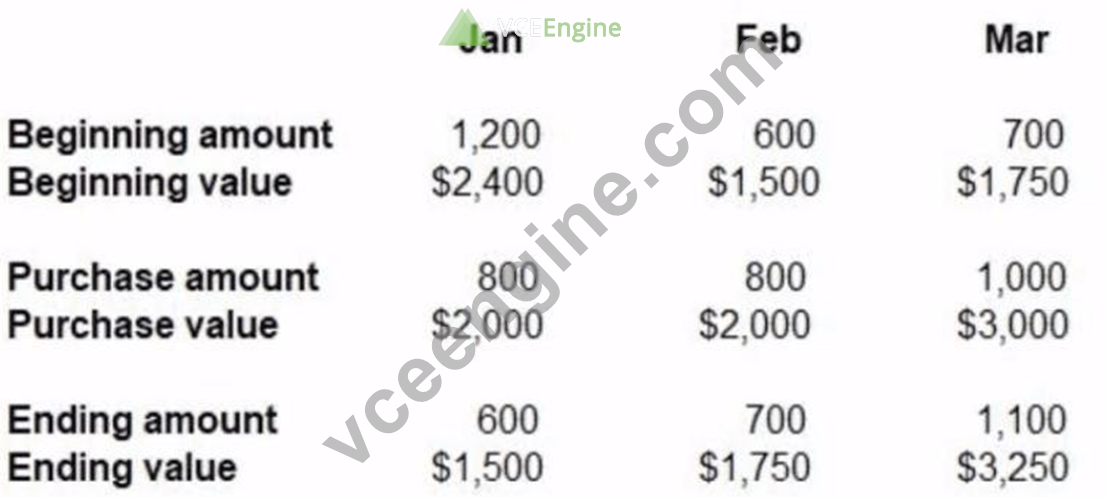
- A. net weight scale
- B. LIFO
- C. average cost
- D. FIFO
Answer: C
Explanation:
The organization's inventory records show that the beginning and ending amounts and values change each month, and the relationship between units and dollar values suggests that the cost per unit is averaged, not fixed (as with FIFO or LIFO). Let's evaluate January:
Beginning: 1,200 units / $2,400 # $2.00 per unit
Purchased: 800 units / $2,000 # $2.50 per unit
Ending: 600 units / $1,500 # $2.50 per unit
The ending value of $1,500 for 600 units gives a per-unit cost of $2.50, matching the purchase cost in January. This suggests the system uses a weighted average cost method rather than tracking the specific cost layers (as FIFO or LIFO would).
Relevant References:
FASAB SFFAS No. 3 - Accounting for Inventory and Related Property
GAAP and GASB guidelines on inventory valuation
GFOA Best Practices - Inventory and Supply Chain Management
B). average cost
NEW QUESTION # 39
A municipality would establish an internal service fund to capture the activities of a data processing center, in order to account for
- A. proceeds of revenue sources restricted to expenditure for specified purposes.
- B. financing of services provided to other governmental units on a cost reimbursement basis.
- C. services rendered to the general public on a fee basis.
- D. financial resources to be used for acquisition of facilities.
Answer: B
Explanation:
Comprehensive Detailed Explanation:
Internal service funds are proprietary funds used to account for the operations of departments or functions that provide goods or services to other departments within the same government on a cost-reimbursement basis.
Examples include:
Centralized IT/data processing
Fleet management
Print shops or mail centers
These are not used for general public services, capital acquisitions, or restricted revenues (which belong in special revenue or capital projects funds).
Relevant References:
GASB Statement No. 34 - Fund Types
GASB Codification Section 1300 - Internal Service Funds
GFOA Fund Accounting Best Practices
D). financing of services provided to other governmental units on a cost reimbursement basis.
NEW QUESTION # 40
State and local governments account for budgeted and actual expenditures to ensure that
- A. cash is available to pay bills when they come due.
- B. spending conforms to legal requirements.
- C. GASB standards are met when producing the basic financial statements.
- D. actual expenditures are used to formulate next year's budget.
Answer: B
Explanation:
State and local governments adopt legally binding budgets and are required to monitor compliance with those budgets. Budget-to-actual comparisons help ensure that public funds are spent only as authorized by the legislative body. This supports the core accountability principle of public sector financial reporting.
While budgets can also support planning and cash flow, the primary purpose of tracking budgeted vs. actual expenditures is legal compliance.
Relevant References:
GASB Statement No. 34 - Budgetary Comparison Schedules
GFOA - Budget Monitoring and Compliance
GAO Red Book - Legal Requirements for Public Spending
D). spending conforms to legal requirements.
NEW QUESTION # 41
An agency's Fund Balance with Treasury is increased by which of the following events?
- A. a recovery of prior year obligations
- B. collection of custodial revenue
- C. receipt of a Treasury warrant
- D. rescission of an appropriation
Answer: C
Explanation:
Fund Balance with Treasury (FBWT) increases when an agency receives a Treasury warrant. A warrant is the official document issued by the U.S. Treasury that provides budgetary authority to the agency and establishes funds available for obligation and disbursement.
Other options:
Rescission of appropriation # decreases FBWT
Recovery of prior-year obligations # may restore budgetary authority, but not necessarily FBWT Custodial revenue # collected on behalf of others; not retained by the collecting agency Relevant References:
Treasury Financial Manual (TFM), Volume I, Part 2, Chapter 5100
FASAB SFFAS No. 1 - Fund Balance with Treasury
USSGL Guidance on Fund Balance Transactions
A). receipt of a Treasury warrant
NEW QUESTION # 42
Using the cost recovery method of recognizing revenue, premiums are recognized as revenue
- A. when received.
- B. when the policy takes effect.
- C. once the ultimate premium can be reasonably estimated.
- D. throughout the duration of the policy when claim costs are incurred.
Answer: D
Explanation:
Under the cost recovery method, revenue is recognized only as costs are recovered. In the context of insurance or risk-financing activities (such as self-insurance), GASB and FASAB require that premium revenues be recognized over the term of the policy, in proportion to the recognition of related costs (e.g., claims incurred).
This aligns revenue with expenses and ensures no profit is recognized before related obligations are met.
Relevant References:
FASAB SFFAS No. 7 - Revenue and Other Financing Sources
GASB Statement No. 10 - Accounting for Risk Financing and Related Insurance Issues GFOA Risk Management and Insurance Practices B). throughout the duration of the policy when claim costs are incurred
NEW QUESTION # 43
An idle facility cost is an allowable expense to charge to federal grants when a
- A. facility cannot be used while it is being repaired.
- B. facility is not currently needed by the agency.
- C. fluctuation in workload is reasonably expected.
- D. facility will sit idle for over one year.
Answer: C
Explanation:
Comprehensive Detailed Explanation:
Under 2 CFR § 200.446 of the OMB Uniform Guidance, idle facilities (or idle capacity) costs are generally unallowable. However, exceptions exist. One allowable condition is when the idleness results from fluctuations in workload that are considered normal for the type of operation.
Other allowable cases include those due to reorganization, restraint, or repair/maintenance needs - but only within reasonable limits and duration.
Relevant References:
2 CFR § 200.446 - Idle Facilities and Idle Capacity
OMB Uniform Guidance (2 CFR Part 200) - Cost Principles
GAO Red Book - Allowable Grant Expenditures
A). fluctuation in workload is reasonably expected
##################################
NEW QUESTION # 44
According to GASB, when should landfill closure and post-closure costs be recognized?
- A. when the landfill is closed
- B. each year the landfill is operating
- C. when payments for costs are made
- D. every five years until the landfill is closed
Answer: B
Explanation:
Comprehensive Detailed Explanation:
According to GASB Statement No. 18 (Accounting for Municipal Solid Waste Landfill Closure and Postclosure Care Costs), governments must recognize a portion of closure and post-closure costs each year as the landfill's capacity is used.
This is done using the "units-of-consumption" method, meaning costs are accrued in proportion to how much of the landfill's total capacity has been filled. The total estimated cost is spread over the useful life of the landfill.
Relevant References:
GASB Statement No. 18 - Landfill Closure and Postclosure Costs
GASB Codification Section L10.103
GFOA Environmental Liabilities Guidance
D). each year the landfill is operating
NEW QUESTION # 45
Which of the following revenue sources is an exchange-like transaction?
- A. operating permits
- B. fines
- C. grants
- D. income taxes
Answer: A
Explanation:
Exchange and exchange-like transactions occur when each party receives and gives up essentially equal value.
In the case of operating permits (e.g., business licenses or environmental permits), the payer receives a direct and proportional benefit in exchange for the fee paid, making this an exchange-like transaction.
In contrast:
Income taxes and fines are non-exchange revenues.
Grants may or may not be exchange-like, depending on stipulations, but generally are non-exchange.
Relevant Standards and References:
GASB Statement No. 33, Accounting and Financial Reporting for Nonexchange Transactions GASB Codification Section N50, Nonexchange Transactions GFOA Best Practices - Revenue Recognition Therefore, Option B is correct.
NEW QUESTION # 46
Purchase orders are issued in the amount of $427,000. The general ledger entry to record the encumbrance should be
- A. Debit Fund Balance $427,000 Credit Encumbrances $427,000
- B. Debit Encumbrances $427,000 Credit Expenditures $427,000
- C. Debit Encumbrances $427,000 Credit Budgetary Fund Balance $427,000
- D. Debit Appropriations $427,000 Credit Encumbrances $427,000
Answer: C
Explanation:
When a government issues purchase orders, it records encumbrances to reflect commitments against appropriations. This helps track budgetary commitments and avoid overspending.
The entry is recorded in the budgetary accounts (not proprietary accounts) as follows:
Debit Encumbrances: Recognizes the commitment
Credit Budgetary Fund Balance (or Reserve for Encumbrances): Reflects that part of the fund balance is committed This is consistent with modified accrual accounting and standard governmental fund practice.
Relevant References:
GASB Codification Section 1300 - Budgetary Accounting
GFOA Best Practices - Encumbrance Accounting
GAO Principles of Appropriation Law - Encumbrance Controls
D). Debit Encumbrances $427,000; Credit Budgetary Fund Balance $427,000
NEW QUESTION # 47
If an internal service fund needs to develop an hourly billing rate, the calculation should include
- A. the acquisition cost of equipment purchased during the year.
- B. all materials consumed during the year.
- C. the replacement cost of equipment purchased during the year.
- D. all materials purchased during the year, even if the materials were not consumed.
Answer: B
Explanation:
An internal service fund is used to account for goods or services provided by one department or agency to other departments or agencies of the governmental unit, typically on a cost-reimbursement basis.
To establish accurate billing rates (e.g., hourly rates), the fund must use actual costs of providing services.
This includes materials consumed, labor, depreciation, and overhead. Materials purchased but not used should not be included in the rate calculation for the current period.
Relevant Standards and References:
FASAB SFFAS No. 4, Managerial Cost Accounting
GASB Codification Section 1800, Internal Service Funds
GFOA Best Practices - Internal Service Fund Rate Setting
Therefore, Option A is correct.
NEW QUESTION # 48
In state and local financial audits, material weaknesses must be reported to the
- A. governing body.
- B. taxpayers.
- C. legislature.
- D. local media.
Answer: A
Explanation:
What Are Material Weaknesses?
* Amaterial weaknessin internal control is a deficiency or combination of deficiencies that creates a reasonable possibility of a material misstatement in the financial statements that would not be prevented or detected in a timely manner.
* In the context of state and local financial audits, material weaknesses must be reported to those charged with governance, as they are responsible for oversight and corrective actions.
Why Is the Governing Body the Correct Answer?
* Thegoverning body(e.g., city council, county board, or state commission) is directly responsible for overseeing the entity's financial operations and ensuring accountability. Reporting material weaknesses to them ensures that corrective actions can be implemented to strengthen internal controls.
* Auditors communicate such findings through anaudit reportor amanagement letteraddressed to the governing body.
Why Other Options Are Incorrect:
* A. Legislature:The legislature may have oversight of state budgets and appropriations but is not the direct governing body for financial audits.
* C. Taxpayers:While transparency is important, material weaknesses are not directly reported to taxpayers. They may be disclosed in public audit reports, but taxpayers are not the primary audience.
* D. Local media:Material weaknesses are not formally reported to the media; their disclosure depends on the entity's public reporting processes.
References and Documents:
* GAO Yellow Book (GAGAS):Requires auditors to report material weaknesses to those charged with governance.
* GASB (Governmental Accounting Standards Board):Emphasizes the importance of communicating significant audit findings to governing bodies.
* AICPA Audit Standards (AU-C 265):Requires auditors to communicate material weaknesses to management and those charged with governance.
NEW QUESTION # 49
In exchange and exchange-like transactions the government
- A. neither gives up nor receives assets.
- B. receives value without directly giving up value in return.
- C. provides service at no cost to the user.
- D. receives value and gives up essentially the same value.
Answer: D
Explanation:
Comprehensive Detailed Explanation:
In governmental accounting, an exchange transaction occurs when each party receives and gives up essentially equal value. Exchange-like transactions are similar but may lack one or more of the characteristics of a pure exchange (e.g., pricing may not be market-based).
Examples:
A city charges fees for utilities: the user pays for services and the city provides equivalent value.
Grants and taxes are nonexchange transactions because the payer does not receive a direct, equivalent benefit in return.
Relevant References:
GASB Statement No. 33 - Accounting and Financial Reporting for Nonexchange Transactions GASB Concepts Statement No. 4 - Elements of Financial Statements B). receives value and gives up essentially the same value.
NEW QUESTION # 50
......
GAFRB dumps Exam Material with 117 Questions: https://testking.vceengine.com/GAFRB-vce-test-engine.html
