

Quality FCSS_SOC_AN-7.4 PDF Dumps - FCSS_SOC_AN-7.4 Exam Questions
Most UptoDate Fortinet FCSS_SOC_AN-7.4 Exam Dumps PDF 2025
Fortinet FCSS_SOC_AN-7.4 Exam Syllabus Topics:
| Topic | Details |
|---|---|
| Topic 1 |
|
| Topic 2 |
|
| Topic 3 |
|
| Topic 4 |
|
NEW QUESTION # 23
When does FortiAnalyzer generate an event?
- A. When a log matches a filter in a data selector
- B. When a log matches a task in a playbook
- C. When a log matches an action in a connector
- D. When a log matches a rule in an event handler
Answer: D
Explanation:
Understanding Event Generation in FortiAnalyzer:
FortiAnalyzer generates events based on predefined rules and conditions to help in monitoring and responding to security incidents.
Analyzing the Options:
Option A: Data selectors filter logs based on specific criteria but do not generate events on their own.
Option B: Connectors facilitate integrations with other systems but do not generate events based on log matches.
Option C: Event handlers are configured with rules that define the conditions under which events are generated. When a log matches a rule in an event handler, FortiAnalyzer generates an event.
Option D: Tasks in playbooks execute actions based on predefined workflows but do not directly generate events based on log matches.
Conclusion:
FortiAnalyzer generates an event when a log matches a rule in an event handler.
Reference: Fortinet Documentation on Event Handlers and Event Generation in FortiAnalyzer.
Best Practices for Configuring Event Handlers in FortiAnalyzer.
NEW QUESTION # 24
While monitoring your network, you discover that one FortiGate device is sending significantly more logs to FortiAnalyzer than all of the other FortiGate devices in the topology.
Additionally, the ADOM that the FortiGate devices are registered to consistently exceeds its quota.
What are two possible solutions? (Choose two.)
- A. Reconfigure the first FortiGate device to reduce the number of logs it forwards to FortiAnalyzer.
- B. Configure data selectors to filter the data sent by the first FortiGate device.
- C. Increase the storage space quota for the first FortiGate device.
- D. Create a separate ADOM for the first FortiGate device and configure a different set of storage policies.
Answer: A,D
Explanation:
* Understanding the Problem:
* One FortiGate device is generating a significantly higher volume of logs compared to other devices, causing the ADOM to exceed its storage quota.
* This can lead to performance issues and difficulties in managing logs effectively within FortiAnalyzer.
* Possible Solutions:
* The goal is to manage the volume of logs and ensure that the ADOM does not exceed its quota, while still maintaining effective log analysis and monitoring.
* Solution A: Increase the Storage Space Quota for the First FortiGate Device:
* While increasing the storage space quota might provide a temporary relief, it does not address the root cause of the issue, which is the excessive log volume.
* This solution might not be sustainable in the long term as log volume could continue to grow.
* Not selected as it does not provide a long-term, efficient solution.
* Solution B: Create a Separate ADOM for the First FortiGate Device and Configure a Different Set of Storage Policies:
* Creating a separate ADOM allows for tailored storage policies and management specifically for the high-log-volume device.
* This can help in distributing the storage load and applying more stringent or customized retention and storage policies.
* Selected as it effectively manages the storage and organization of logs.
* Solution C: Reconfigure the First FortiGate Device to Reduce the Number of Logs it Forwards to FortiAnalyzer:
* By adjusting the logging settings on the FortiGate device, you can reduce the volume of logs forwarded to FortiAnalyzer.
* This can include disabling unnecessary logging, reducing the logging level, or filtering out less critical logs.
* Selected as it directly addresses the issue of excessive log volume.
* Solution D: Configure Data Selectors to Filter the Data Sent by the First FortiGate Device:
* Data selectors can be used to filter the logs sent to FortiAnalyzer, ensuring only relevant logs are forwarded.
* This can help in reducing the volume of logs but might require detailed configuration and regular updates to ensure critical logs are not missed.
* Not selected as it might not be as effective as reconfiguring logging settings directly on the FortiGate device.
* Implementation Steps:
* For Solution B:
* Step 1: Access FortiAnalyzer and navigate to the ADOM management section.
* Step 2: Create a new ADOM for the high-log-volume FortiGate device.
* Step 3: Register the FortiGate device to this new ADOM.
* Step 4: Configure specific storage policies for the new ADOM to manage log retention and storage.
* For Solution C:
* Step 1: Access the FortiGate device's configuration interface.
* Step 2: Navigate to the logging settings.
* Step 3: Adjust the logging level and disable unnecessary logs.
* Step 4: Save the configuration and monitor the log volume sent to FortiAnalyzer.
References:
* Fortinet Documentation on FortiAnalyzer ADOMs and log management FortiAnalyzer Administration Guide
* Fortinet Knowledge Base on configuring log settings on FortiGate FortiGate Logging Guide By creating a separate ADOM for the high-log-volume FortiGate device and reconfiguring its logging settings, you can effectively manage the log volume and ensure the ADOM does not exceed its quota.
NEW QUESTION # 25
Refer to the exhibits.
The FortiMail Sender Blocklist playbook is configured to take manual input and add those entries to the FortiMail abc. com domain-level block list. The playbook is configured to use a FortiMail connector and the ADD_SENDER_TO_BLOCKLIST action.
Why is the FortiMail Sender Blocklist playbook execution failing7
- A. FortiMail is expecting a fully qualified domain name (FQDN).
- B. You must use the GET_EMAIL_STATISTICS action first to gather information about email messages.
- C. The connector credentials are incorrect
- D. The client-side browser does not trust the FortiAnalzyer self-signed certificate.
Answer: A
Explanation:
Understanding the Playbook Configuration:
The playbook "FortiMail Sender Blocklist" is designed to manually input email addresses or IP addresses and add them to the FortiMail block list.
The playbook uses a FortiMail connector with the action ADD_SENDER_TO_BLOCKLIST.
Analyzing the Playbook Execution:
The configuration and actions provided show that the playbook is straightforward, starting with an ON_DEMAND STARTER and proceeding to the ADD_SENDER_TO_BLOCKLIST action.
The action description indicates it is intended to block senders based on email addresses or domains.
Evaluating the Options:
Option A: Using GET_EMAIL_STATISTICS is not required for the task of adding senders to a block list.
This action retrieves email statistics and is unrelated to the block list configuration.
Option B: The primary reason for failure could be the requirement for a fully qualified domain name (FQDN). FortiMail typically expects precise information to ensure the correct entries are added to the block list.
Option C: The trust level of the client-side browser with FortiAnalyzer's self-signed certificate does not impact the execution of the playbook on FortiMail.
Option D: Incorrect connector credentials would result in an authentication error, but the problem described is more likely related to the format of the input data. Conclusion:
The FortiMail Sender Blocklist playbook execution is failing because FortiMail is expecting a fully qualified domain name (FQDN).
Reference: Fortinet Documentation on FortiMail Connector Actions.
Best Practices for Configuring FortiMail Block Lists.
NEW QUESTION # 26
What is the primary goal of a Security Operations Center (SOC) when analyzing security incidents?
- A. To manage IT support tickets
- B. To improve network performance
- C. To identify and respond to security threats
- D. To enforce compliance with data protection laws
Answer: C
NEW QUESTION # 27
Which trigger type requires manual input to run a playbook?
- A. INCIDENT_TRIGGER
- B. ON_DEMAND
- C. ON_SCHEDULE
- D. EVENT_TRIGGER
Answer: B
NEW QUESTION # 28
Which of the following best describes a benefit of a well-configured FortiAnalyzer Fabric deployment?
- A. Improved log correlation and threat detection
- B. Enhanced corporate branding
- C. Reduced need for technical support
- D. Increased physical security of servers
Answer: A
NEW QUESTION # 29
What is a key consideration when designing a scalable FortiAnalyzer deployment?
- A. The color scheme of the dashboard
- B. The future increase in log volume
- C. The branding of the user interface
- D. The integration with third-party tools
Answer: B
NEW QUESTION # 30
Which two playbook triggers enable the use of trigger events in later tasks as trigger variables? (Choose two.)
- A. ON SCHEDULE
- B. INCIDENT
- C. ON DEMAND
- D. EVENT
Answer: B,D
Explanation:
* Understanding Playbook Triggers:
* Playbook triggers are the starting points for automated workflows within FortiAnalyzer or FortiSOAR.
* These triggers determine how and when a playbook is executed and can pass relevant information (trigger variables) to subsequent tasks within the playbook.
* Types of Playbook Triggers:
* EVENT Trigger:
* Initiates the playbook when a specific event occurs.
* The event details can be used as variables in later tasks to customize the response.
* Selected as it allows using event details as trigger variables.
* INCIDENT Trigger:
* Activates the playbook when an incident is created or updated.
* The incident details are available as variables in subsequent tasks.
* Selected as it enables the use of incident details as trigger variables.
* ON SCHEDULE Trigger:
* Executes the playbook at specified times or intervals.
* Does not inherently use trigger events to pass variables to later tasks.
* Not selected as it does not involve passing trigger event details.
* ON DEMAND Trigger:
* Runs the playbook manually or as required.
* Does not automatically include trigger event details for use in later tasks.
* Not selected as it does not use trigger events for variables.
* Implementation Steps:
* Step 1: Define the conditions for the EVENT or INCIDENT trigger in the playbook configuration.
* Step 2: Use the details from the trigger event or incident in subsequent tasks to customize actions and responses.
* Step 3: Test the playbook to ensure that the trigger variables are correctly passed and utilized.
* Conclusion:
* EVENT and INCIDENT triggers are specifically designed to initiate playbooks based on specific occurrences, allowing the use of trigger details in subsequent tasks.
References:
* Fortinet Documentation on Playbook Configuration FortiSOAR Playbook Guide By using the EVENT and INCIDENT triggers, you can leverage trigger events in later tasks as variables, enabling more dynamic and responsive playbook actions.
NEW QUESTION # 31
Refer to Exhibit:
A SOC analyst is creating the Malicious File Detected playbook to run when FortiAnalyzer generates a malicious file event. The playbook must also update the incident with the malicious file event data.
What must the next task in this playbook be?
- A. A local connector with the action Update Asset and Identity
- B. A local connector with the action Update Incident
- C. A local connector with the action Run Report
- D. A local connector with the action Attach Data to Incident
Answer: B
Explanation:
Understanding the Playbook and its Components:
The exhibit shows a playbook in which an event trigger starts actions upon detecting a malicious file.
The initial tasks in the playbook include CREATE_INCIDENT and GET_EVENTS.
Analysis of Current Tasks:
EVENT_TRIGGER STARTER: This initiates the playbook when a specified event (malicious file detection) occurs.
CREATE_INCIDENT: This task likely creates a new incident in the incident management system for tracking and response.
GET_EVENTS: This task retrieves the event details related to the detected malicious file.
Objective of the Next Task:
The next logical step after creating an incident and retrieving event details is to update the incident with the event data, ensuring all relevant information is attached to the incident record.
This helps SOC analysts by consolidating all pertinent details within the incident record, facilitating efficient tracking and response.
Evaluating the Options:
Option A: Update Asset and Identity is not directly relevant to attaching event data to the incident.
Option B: Attach Data to Incident sounds plausible but typically, updating an incident involves more comprehensive changes including status updates, adding comments, and other data modifications.
Option C: Run Report is irrelevant in this context as the goal is to update the incident with event data.
Option D: Update Incident is the most suitable action for incorporating event data into the existing incident record.
Conclusion:
The next task in the playbook should be to update the incident with the event data to ensure the incident reflects all necessary information for further investigation and response.
Reference: Fortinet Documentation on Playbook Creation and Incident Management.
Best Practices for Automating Incident Response in SOC Operations.
NEW QUESTION # 32
Refer to the exhibit.
Assume that all devices in the FortiAnalyzer Fabric are shown in the image.
Which two statements about the FortiAnalyzer Fabric deployment are true? (Choose two.)
- A. FortiGate-B1 and FortiGate-B2 are in a Security Fabric.
- B. All FortiGate devices are directly registered to the supervisor.
- C. FAZ-SiteA has two ADOMs enabled.
- D. There is no collector in the topology.
Answer: A,C
Explanation:
* Understanding the FortiAnalyzer Fabric:
* The FortiAnalyzer Fabric provides centralized log collection, analysis, and reporting for connected FortiGate devices.
* Devices in a FortiAnalyzer Fabric can be organized into different Administrative Domains (ADOMs) to separate logs and management.
* Analyzing the Exhibit:
* FAZ-SiteAandFAZ-SiteBare FortiAnalyzer devices in the fabric.
* FortiGate-B1andFortiGate-B2are shown under theSite-B-Fabric, indicating they are part of the same Security Fabric.
* FAZ-SiteAhas multiple entries under it:SiteAandMSSP-Local, suggesting multiple ADOMs are enabled.
* Evaluating the Options:
* Option A:FortiGate-B1 and FortiGate-B2 are underSite-B-Fabric, indicating they are indeed part of the same Security Fabric.
* Option B:The presence of FAZ-SiteA and FAZ-SiteB as FortiAnalyzers does not preclude the existence of collectors. However, there is no explicit mention of a separate collector role in the exhibit.
* Option C:Not all FortiGate devices are directly registered to the supervisor. The exhibit shows hierarchical organization under different sites and ADOMs.
* Option D:The multiple entries underFAZ-SiteA(SiteA and MSSP-Local) indicate that FAZ-SiteA has two ADOMs enabled.
* Conclusion:
* FortiGate-B1 and FortiGate-B2 are in a Security Fabric.
* FAZ-SiteA has two ADOMs enabled.
References:
* Fortinet Documentation on FortiAnalyzer Fabric Topology and ADOM Configuration.
* Best Practices for Security Fabric Deployment with FortiAnalyzer.
NEW QUESTION # 33
Which outcome indicates successful integration of connectors in a SOC playbook?
- A. Seamless interaction between different security systems
- B. Frequent need for system reboots
- C. High visibility of internal operations to the public
- D. Increased manual interventions in processes
Answer: A
NEW QUESTION # 34
Exhibit:
Which observation about this FortiAnalyzer Fabric deployment architecture is true?
- A. The EMEA SOC team has access to historical logs only.
- B. The APAC SOC team has access to FortiView and other reporting functions.
- C. The AMER HQ SOC team cannot run automation playbooks from the Fabric supervisor.
- D. The AMER HQ SOC team must configure high availability (HA) for the supervisor node.
Answer: C
Explanation:
* Understanding FortiAnalyzer Fabric Deployment:
* FortiAnalyzer Fabric deployment involves a hierarchical structure where the Fabric root (supervisor) coordinates with multiple Fabric members (collectors and analyzers).
* This setup ensures centralized log collection, analysis, and incident response across geographically distributed locations.
* Analyzing the Exhibit:
* FAZ1-Supervisoris located at AMER HQ and acts as the Fabric root.
* FAZ2-Analyzeris a Fabric member located in EMEA.
* FAZ3-CollectorandFAZ4-Collectorare Fabric members located in EMEA and APAC, respectively.
* Evaluating the Options:
* Option A:The statement indicates that the AMER HQ SOC team cannot run automation playbooks from the Fabric supervisor. This is true because automation playbooks and certain orchestration tasks typically require local execution capabilities which may not be fully supported on the supervisor node.
* Option B:High availability (HA) configuration for the supervisor node is a best practice for redundancy but is not directly inferred from the given architecture.
* Option C:The EMEA SOC team having access to historical logs only is not correct since FAZ2-Analyzer provides full analysis capabilities.
* Option D:The APAC SOC team has access to FortiView and other reporting functions through FAZ4-Collector, but this is not explicitly detailed in the provided architecture.
* Conclusion:
* The most accurate observation about this FortiAnalyzer Fabric deployment architecture is that the AMER HQ SOC team cannot run automation playbooks from the Fabric supervisor.
References:
* Fortinet Documentation on FortiAnalyzer Fabric Deployment.
* Best Practices for FortiAnalyzer and Automation Playbooks.
NEW QUESTION # 35
Refer to the exhibits.
You configured a custom event handler and an associated rule to generate events whenever FortiMail detects spam emails. However, you notice that the event handler is generating events for both spam emails and clean emails.
Which change must you make in the rule so that it detects only spam emails?
- A. In the Log filter by Text field, type type==spam.
- B. In the Log Type field, select Anti-Spam Log (spam)
- C. In the Trigger an event when field, select Within a group, the log field Spam Name (snane) has 2 or more unique values.
- D. Disable the rule to use the filter in the data selector to create the event.
Answer: B
Explanation:
Understanding the Custom Event Handler Configuration:
The event handler is set up to generate events based on specific log data.
The goal is to generate events specifically for spam emails detected by FortiMail.
Analyzing the Issue:
The event handler is currently generating events for both spam emails and clean emails.
This indicates that the rule's filtering criteria are not correctly distinguishing between spam and non- spam emails.
Evaluating the Options:
Option A: Selecting the "Anti-Spam Log (spam)" in the Log Type field will ensure that only logs related to spam emails are considered. This is the most straightforward and accurate way to filter for spam emails.
Option B: Typing type==spam in the Log filter by Text field might help filter the logs, but it is not as direct and reliable as selecting the correct log type.
Option C: Disabling the rule to use the filter in the data selector to create the event does not address the issue of filtering for spam logs specifically.
Option D: Selecting "Within a group, the log field Spam Name (snane) has 2 or more unique values" is not directly relevant to filtering spam logs and could lead to incorrect filtering criteria. Conclusion:
The correct change to make in the rule is to select "Anti-Spam Log (spam)" in the Log Type field. This ensures that the event handler only generates events for spam emails.
Reference: Fortinet Documentation on Event Handlers and Log Types.
Best Practices for Configuring FortiMail Anti-Spam Settings.
NEW QUESTION # 36
Review the following incident report:
Attackers leveraged a phishing email campaign targeting your employees.
The email likely impersonated a trusted source, such as the IT department, and requested login credentials.
An unsuspecting employee clicked a malicious link in the email, leading to the download and execution of a Remote Access Trojan (RAT).
The RAT provided the attackers with remote access and a foothold in the compromised system.
Which two MITRE ATT&CK tactics does this incident report capture? (Choose two.)
- A. Initial Access
- B. Persistence
- C. Lateral Movement
- D. Defense Evasion
Answer: A,B
Explanation:
* Understanding the MITRE ATT&CK Tactics:
* The MITRE ATT&CK framework categorizes various tactics and techniques used by adversaries to achieve their objectives.
* Tactics represent the objectives of an attack, while techniques represent how those objectives are achieved.
* Analyzing the Incident Report:
* Phishing Email Campaign:This tactic is commonly used for gaining initial access to a system.
* Malicious Link and RAT Download:Clicking a malicious link and downloading a RAT is indicative of establishing initial access.
* Remote Access Trojan (RAT):Once installed, the RAT allows attackers to maintain access over an extended period, which is a persistence tactic.
* Mapping to MITRE ATT&CK Tactics:
* Initial Access:
* This tactic covers techniques used to gain an initial foothold within a network.
* Techniques include phishing and exploiting external remote services.
* The phishing campaign and malicious link click fit this category.
* Persistence:
* This tactic includes methods that adversaries use to maintain their foothold.
* Techniques include installing malware that can survive reboots and persist on the system.
* The RAT provides persistent remote access, fitting this tactic.
* Exclusions:
* Defense Evasion:
* This involves techniques to avoid detection and evade defenses.
* While potentially relevant in a broader context, the incident report does not specifically describe actions taken to evade defenses.
* Lateral Movement:
* This involves moving through the network to other systems.
* The report does not indicate actions beyond initial access and maintaining that access.
Conclusion:
* The incident report captures the tactics ofInitial AccessandPersistence.
References:
* MITRE ATT&CK Framework documentation on Initial Access and Persistence tactics.
* Incident analysis and mapping to MITRE ATT&CK tactics.
NEW QUESTION # 37
Which FortiAnalyzer connector can you use to run automation stitches9
- A. FortiOS
- B. FortiCASB
- C. Local
- D. FortiMail
Answer: A
Explanation:
Overview of Automation Stitches:
Automation stitches in FortiAnalyzer are predefined sets of automated actions triggered by specific events. These actions help in automating responses to security incidents, improving efficiency, and reducing the response time.
FortiAnalyzer Connectors:
FortiAnalyzer integrates with various Fortinet products and other third-party solutions through connectors. These connectors facilitate communication and data exchange, enabling centralized management and automation.
Available Connectors for Automation Stitches:
FortiCASB:
FortiCASB is a Cloud Access Security Broker that helps secure SaaS applications. However, it is not typically used for running automation stitches within FortiAnalyzer.
Reference: Fortinet FortiCASB Documentation FortiCASB
FortiMail:
FortiMail is an email security solution. While it can send logs and events to FortiAnalyzer, it is not primarily used for running automation stitches.
Reference: Fortinet FortiMail Documentation FortiMail
Local:
The local connector refers to FortiAnalyzer's ability to handle logs and events generated by itself. This is useful for internal processes but not specifically for integrating with other Fortinet devices for automation stitches.
Reference: Fortinet FortiAnalyzer Administration Guide FortiAnalyzer Local FortiOS:
FortiOS is the operating system that runs on FortiGate firewalls. FortiAnalyzer can use the FortiOS connector to communicate with FortiGate devices and run automation stitches. This allows FortiAnalyzer to send commands to FortiGate, triggering predefined actions in response to specific events.
Reference: Fortinet FortiOS Administration Guide FortiOS Detailed Process:
Step 1: Configure the FortiOS connector in FortiAnalyzer to establish communication with FortiGate devices.
Step 2: Define automation stitches within FortiAnalyzer that specify the actions to be taken when certain events occur.
Step 3: When a triggering event is detected, FortiAnalyzer uses the FortiOS connector to send the necessary commands to the FortiGate device.
Step 4: FortiGate executes the commands, performing the predefined actions such as blocking an IP address, updating firewall rules, or sending alerts. Conclusion:
The FortiOS connector is specifically designed for integration with FortiGate devices, enabling FortiAnalyzer to execute automation stitches effectively.
Reference: Fortinet FortiOS Administration Guide: Details on configuring and using automation stitches.
Fortinet FortiAnalyzer Administration Guide: Information on connectors and integration options.
By utilizing the FortiOS connector, FortiAnalyzer can run automation stitches to enhance the security posture and response capabilities within a network.
NEW QUESTION # 38
Which role does a threat hunter play within a SOC?
- A. Collect evidence and determine the impact of a suspected attack
- B. investigate and respond to a reported security incident
- C. Monitor network logs to identify anomalous behavior
- D. Search for hidden threats inside a network which may have eluded detection
Answer: D
Explanation:
* Role of a Threat Hunter:
* A threat hunter proactively searches for cyber threats that have evaded traditional security defenses. This role is crucial in identifying sophisticated and stealthy adversaries that bypass automated detection systems.
* Key Responsibilities:
* Proactive Threat Identification:
* Threat hunters use advanced tools and techniques to identify hidden threats within the network. This includes analyzing anomalies, investigating unusual behaviors, and utilizing threat intelligence.
NEW QUESTION # 39
Review the following incident report.
Which two MITRE ATT&CK tactics are captured in this report? (Choose two.)
- A. Priviledge Escalation
- B. Reconnaissance
- C. Execution
- D. Defense Evasion
Answer: B,C
NEW QUESTION # 40
Which configuration would enhance the efficiency of a FortiAnalyzer deployment in terms of data throughput?
- A. Reducing the number of backup locations
- B. Decreasing the report generation frequency
- C. Increasing the number of collectors
- D. Lowering the security settings
Answer: C
NEW QUESTION # 41
In the context of threat hunting, which information feeds are most beneficial?
- A. Marketing data
- B. Stock market trends
- C. Corporate governance updates
- D. Cyber threat intelligence
Answer: D
NEW QUESTION # 42
Refer to the exhibit.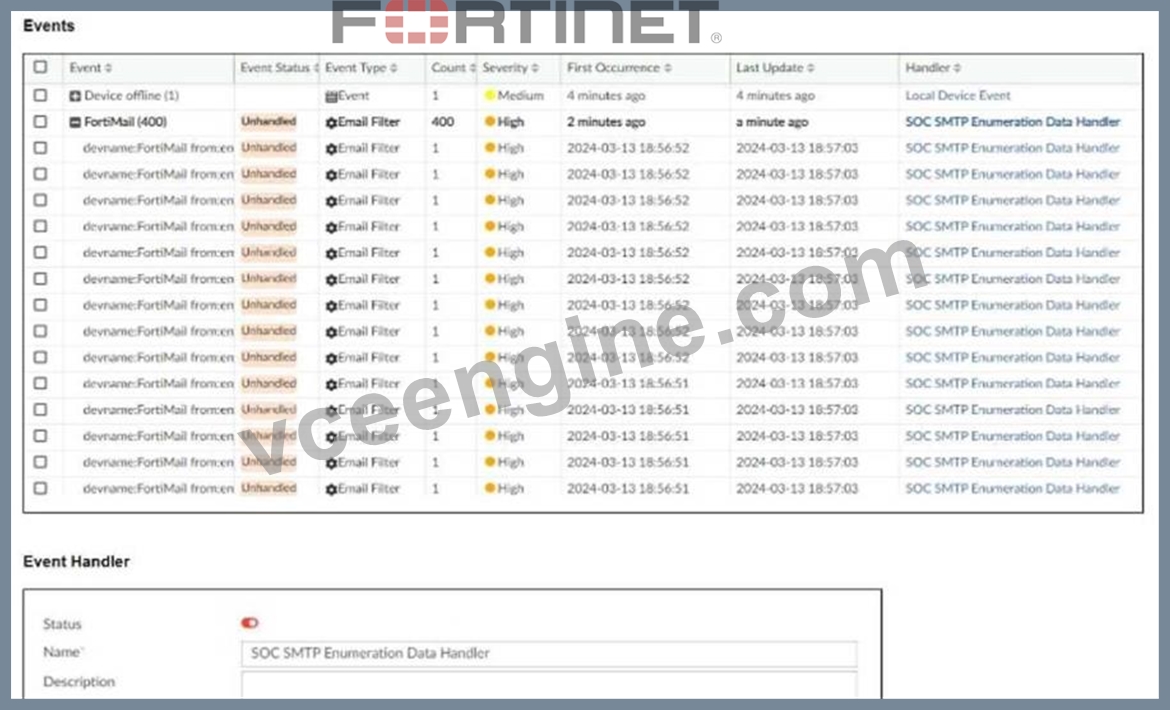
You notice that the custom event handler you configured to detect SMTP reconnaissance activities is creating a large number of events. This is overwhelming your notification system.
How can you fix this?
- A. Increase the log field value so that it looks for more unique field values when it creates the event.
- B. Decrease the time range that the custom event handler covers during the attack.
- C. Increase the trigger count so that it identifies and reduces the count triggered by a particular group.
- D. Disable the custom event handler because it is not working as expected.
Answer: C
Explanation:
Understanding the Issue:
The custom event handler for detecting SMTP reconnaissance activities is generating a large number of events.
This high volume of events is overwhelming the notification system, leading to potential alert fatigue and inefficiency in incident response.
Event Handler Configuration:
Event handlers are configured to trigger alerts based on specific criteria.
The frequency and volume of these alerts can be controlled by adjusting the trigger conditions.
Possible Solutions:
A . Increase the trigger count so that it identifies and reduces the count triggered by a particular group:
By increasing the trigger count, you ensure that the event handler only generates alerts after a higher threshold of activity is detected.
This reduces the number of events generated and helps prevent overwhelming the notification system.
Selected as it effectively manages the volume of generated events.
B . Disable the custom event handler because it is not working as expected:
Disabling the event handler is not a practical solution as it would completely stop monitoring for SMTP reconnaissance activities.
Not selected as it does not address the issue of fine-tuning the event generation.
C . Decrease the time range that the custom event handler covers during the attack: Reducing the time range might help in some cases, but it could also lead to missing important activities if the attack spans a longer period.
Not selected as it could lead to underreporting of significant events.
D . Increase the log field value so that it looks for more unique field values when it creates the event: Adjusting the log field value might refine the event criteria, but it does not directly control the volume of alerts.
Not selected as it is not the most effective way to manage event volume.
Implementation Steps:
Step 1: Access the event handler configuration in FortiAnalyzer.
Step 2: Locate the trigger count setting within the custom event handler for SMTP reconnaissance.
Step 3: Increase the trigger count to a higher value that balances alert sensitivity and volume.
Step 4: Save the configuration and monitor the event generation to ensure it aligns with expected levels.
Conclusion:
By increasing the trigger count, you can effectively reduce the number of events generated by the custom event handler, preventing the notification system from being overwhelmed.
Reference: Fortinet Documentation on Event Handlers and Configuration FortiAnalyzer Administration Guide Best Practices for Event Management Fortinet Knowledge Base By increasing the trigger count in the custom event handler, you can manage the volume of generated events and prevent the notification system from being overwhelmed.
NEW QUESTION # 43
What should be a priority when configuring playbook tasks to ensure effective SOC automation?
- A. Limiting tasks to non-critical alerts
- B. Making tasks visible to external stakeholders
- C. Ensuring tasks are scheduled during office hours only
- D. Aligning tasks with the specific stages of incident response
Answer: D
NEW QUESTION # 44
Why is it crucial to configure playbook triggers based on accurate threat intelligence?
- A. To facilitate easier management of office supplies
- B. To increase the number of digital advertisements
- C. To prevent the triggering of irrelevant or false positive actions
- D. To ensure SOC parties are well-attended
Answer: C
NEW QUESTION # 45
A customer wants FortiAnalyzer to run an automation stitch that executes a CLI command on FortiGate to block a predefined list of URLs, if a botnet command-and-control (C&C) server IP is detected.
Which FortiAnalyzer feature must you use to start this automation process?
- A. Connector
- B. Data selector
- C. Playbook
- D. Event handler
Answer: D
Explanation:
Understanding Automation Processes in FortiAnalyzer:
FortiAnalyzer can automate responses to detected security events, such as running commands on FortiGate devices.
Analyzing the Customer Requirement:
The customer wants to run a CLI command on FortiGate to block predefined URLs when a botnet C&C server IP is detected.
This requires an automated response triggered by a specific event.
Evaluating the Options:
Option A: Playbooks orchestrate complex workflows but are not typically used for direct event-triggered automation processes.
Option B: Data selectors filter logs based on criteria but do not initiate automation processes.
Option C: Event handlers can be configured to detect specific events (such as detecting a botnet C&C server IP) and trigger automation stitches to execute predefined actions.
Option D: Connectors facilitate communication between FortiAnalyzer and other systems but are not the primary mechanism for initiating automation based on log events. Conclusion:
To start the automation process when a botnet C&C server IP is detected, you must use an Event handler in FortiAnalyzer.
Reference: Fortinet Documentation on Event Handlers and Automation Stitches in FortiAnalyzer.
Best Practices for Configuring Automated Responses in FortiAnalyzer.
NEW QUESTION # 46
What should be prioritized when analyzing threat hunting information feeds?
(Choose Two)
- A. Relevance to current security landscape
- B. Accuracy of the information
- C. Frequency of advertisement insertion
- D. Entertainment value of the content
Answer: A,B
NEW QUESTION # 47
Refer to the exhibit.
You notice that the custom event handler you configured to detect SMTP reconnaissance activities is creating a large number of events. This is overwhelming your notification system.
How can you fix this?
- A. Increase the log field value so that it looks for more unique field values when it creates the event.
- B. Decrease the time range that the custom event handler covers during the attack.
- C. Increase the trigger count so that it identifies and reduces the count triggered by a particular group.
- D. Disable the custom event handler because it is not working as expected.
Answer: C
Explanation:
* Understanding the Issue:
* The custom event handler for detecting SMTP reconnaissance activities is generating a large number of events.
* This high volume of events is overwhelming the notification system, leading to potential alert fatigue and inefficiency in incident response.
* Event Handler Configuration:
* Event handlers are configured to trigger alerts based on specific criteria.
* The frequency and volume of these alerts can be controlled by adjusting the trigger conditions.
* Possible Solutions:
* A. Increase the trigger count so that it identifies and reduces the count triggered by a particular group:
* By increasing the trigger count, you ensure that the event handler only generates alerts after a higher threshold of activity is detected.
* This reduces the number of events generated and helps prevent overwhelming the notification system.
* Selected as it effectively manages the volume of generated events.
* B. Disable the custom event handler because it is not working as expected:
* Disabling the event handler is not a practical solution as it would completely stop monitoring for SMTP reconnaissance activities.
* Not selected as it does not address the issue of fine-tuning the event generation.
* C. Decrease the time range that the custom event handler covers during the attack:
* Reducing the time range might help in some cases, but it could also lead to missing important activities if the attack spans a longer period.
* Not selected as it could lead to underreporting of significant events.
* D. Increase the log field value so that it looks for more unique field values when it creates the event:
* Adjusting the log field value might refine the event criteria, but it does not directly control the volume of alerts.
* Not selected as it is not the most effective way to manage event volume.
* Implementation Steps:
* Step 1: Access the event handler configuration in FortiAnalyzer.
* Step 2: Locate the trigger count setting within the custom event handler for SMTP reconnaissance.
* Step 3: Increase the trigger count to a higher value that balances alert sensitivity and volume.
* Step 4: Save the configuration and monitor the event generation to ensure it aligns with expected levels.
* Conclusion:
* By increasing the trigger count, you can effectively reduce the number of events generated by the custom event handler, preventing the notification system from being overwhelmed.
References:
* Fortinet Documentation on Event Handlers and Configuration FortiAnalyzer Administration Guide
* Best Practices for Event Management Fortinet Knowledge Base
By increasing the trigger count in the custom event handler, you can manage the volume of generated events and prevent the notification system from being overwhelmed.
NEW QUESTION # 48
......
100% Free Fortinet Certified Solution Specialist FCSS_SOC_AN-7.4 Dumps PDF Demo Cert Guide Cover: https://testking.vceengine.com/FCSS_SOC_AN-7.4-vce-test-engine.html
