

Best Quality OGEA-103 Exam Questions The Open Group Test To Gain Brilliante Result!
Preparations of OGEA-103 Exam 2026 Enterprise Architecture Unlimited 199 Questions
The TOGAF Enterprise Architecture Combined Part 1 and Part 2 Certification Exam is a valuable certification for enterprise architects and other professionals involved in enterprise architecture initiatives. It demonstrates a candidate's knowledge and skills in applying the TOGAF framework to real-world scenarios, and is recognized globally as a standard for enterprise architecture. With the right preparation and experience, candidates can successfully pass the exam and earn this prestigious certification.
The Open Group OGEA-103 certification exam is ideal for professionals who are interested in taking their career in enterprise architecture to the next level. OGEA-103 exam is designed for individuals who want to demonstrate their expertise in the TOGAF framework and their ability to apply it to real-world situations. TOGAF Enterprise Architecture Combined Part 1 and Part 2 Exam certification is ideal for professionals who want to differentiate themselves in a competitive job market and demonstrate their commitment to professional development.
NEW QUESTION # 114
Consider the following ADM phases objectives.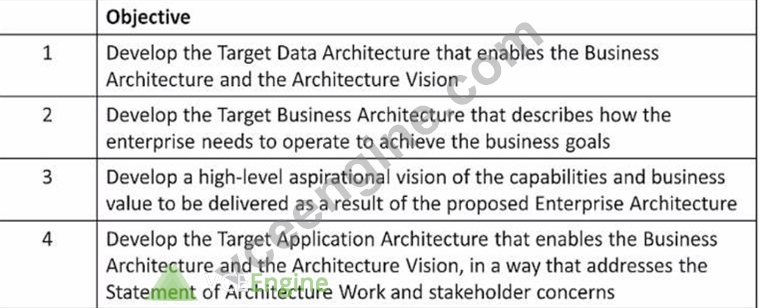
Which phase does each objective match?
- A. 1C-2B-3A-4C
- B. 1B-2D-3A-4C
- C. 1C-2D-3B-4A
- D. 1A-2B-3C-4D
Answer: A
Explanation:
Explanation
The objectives in the table are related to the development of target architectures and the architecture vision, which are the outputs of the following ADM phases:
Phase A: Architecture Vision, which develops a high-level aspirational vision of the capabilities and business value to be delivered as a result of the proposed Enterprise Architecture3 Phase B: Business Architecture, which develops the Target Business Architecture that describes how the enterprise needs to operate to achieve the business goals.
Phase C: Information Systems Architectures, which develops the Target Data Architecture and the Target Application Architecture that enable the Business Architecture and the Architecture Vision, in a way that addresses the Statement of Architecture Work and stakeholder concerns.
Phase D: Technology Architecture, which develops the Target Technology Architecture that enables the logical and physical application and data components, addressing the Statement of Architecture Work and stakeholder concerns.
Therefore, the correct match is 1C-2B-3A-4C, as shown below: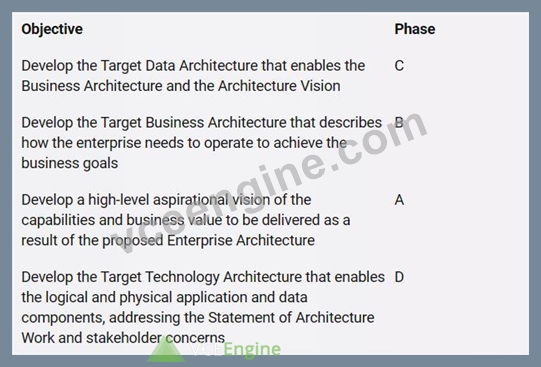
References: 3: The TOGAF Standard, Version 9.2, Part II: Architecture Development Method (ADM), Chapter 18: Phase A: Architecture Vision : The TOGAF Standard, Version 9.2, Part II: Architecture Development Method (ADM), Chapter 19: Phase B: Business Architecture : The TOGAF Standard, Version
9.2, Part II: Architecture Development Method (ADM), Chapter 20: Phase C: Information Systems Architectures : The TOGAF Standard, Version 9.2, Part II: Architecture Development Method (ADM), Chapter 22: Phase D: Technology Architecture
NEW QUESTION # 115
What can be introduced to formalize a joint agreement between development partners and sponsors on the deliverables, quality, and fitness-for-purpose of an architecture?
- A. Non-disclosure Agreement
- B. Architecture Contracts
- C. The Statement of Architecture Work
- D. Service Level Agreements
Answer: B
Explanation:
Comprehensive and Detailed In-Depth Explanation from Expert in Enterprise Architecture, guiding in TOGAF and ArchiMate:
In TOGAF, Architecture Contracts are the formal mechanisms used to define and govern agreements between:
Architecture functions and implementation teams, or
Sponsoring organizations and development partners
Architecture Contracts specify:
Architecture deliverables
Quality criteria and fitness-for-purpose
Roles, responsibilities, and compliance requirements
Governance checkpoints and consequences of non-compliance
Why Option D is correct:
Architecture Contracts explicitly exist to formalize joint agreements regarding architecture outcomes and quality.
Why the other options are incorrect:
A . Service Level Agreements: Focus on operational service performance, not architecture governance.
B . Non-disclosure Agreement: Addresses confidentiality, not architecture deliverables or quality.
C . The Statement of Architecture Work: Defines scope and approach but is not a mutual governance contract.
NEW QUESTION # 116
Please read this scenario prior to answering the question
You are the Lead Enterprise Architect at a major agribusiness company. The company's main harvest is lentils, a highly valued food grown worldwide. The lentil parasite, broomrape, has been an increasing concern for many years and is now becoming resistant to chemical controls. In addition, changes in climate favor the propagation and growth of the parasite. As a result, the parasite cannot realistically be exterminated, and it has become pandemic, with lentil yields falling globally.
In response to the situation, the CEO has decided that the lentil fields will be used for another harvest. The company will also cease to process third-party lentils and will repurpose its processing plants. Thus, the target market will change, and the end-products will be different and more varied.
The company has recently established an Enterprise Architecture practice based on the TOGAF standard as method and guiding framework. The CIO is the sponsor of the activity. A formal request for architecture change has been approved. At this stage there is no fixed scope, shared vision, or objectives.
Refer to the scenario
You have been asked to propose the best approach for architecture development to realize the CEO's change in direction for the company.
Based on the TOGAF standard which of the following is the best answer?
- A. You propose that the team focus on architecture definition including development of business models, with emphasis on defining the change parameters to support this new business strategy that the CEO has identified. Once understood, the team will be in the best position to identify the requirements, drivers, issues, and constraints for the change.
- B. You propose that the team uses the architecture definition document and focus on architecture development starting simultaneously phases B, C and D. This is because the CEO has identified the need to change. This will ensure that the change can be defined in a structured manner and address the requirements needed to realize the change.
- C. You propose that this engagement define the baseline Technology Architecture first in order to assess the current infrastructure capacity and capability for the company. Then the focus should be on transition planning and incremental architecture deployment. This will identify requirements to ensure that the projects are sequenced in an optimal fashion so as to realize the change.
- D. You propose that the priority is to produce a new Request for Architecture Work leading to development of a new Architecture Vision. The trade-off method should be applied to identify and select an architecture satisfying the stakeholders. For an efficient change the EA team should be aligned with the organization's planning, budgeting, operational, and change processes.
Answer: D
Explanation:
A Request for Architecture Work is a document that describes the scope, approach, and expected outcomes of an architecture project. A Request for Architecture Work is usually initiated by the sponsor or client of the architecture work, and approved by the Architecture Board, which is a governance body that oversees the architecture work and ensures compliance with the architecture principles, standards, and goals. A Request for Architecture Work triggers a new cycle of the Architecture Development Method (ADM), which is the core process of the TOGAF standard that guides the development and management of the enterprise architecture12 An Architecture Vision is a high-level description of the desired outcomes and benefits of the proposed architecture. An Architecture Vision is the output of Phase A: Architecture Vision of the ADM cycle, which is the first phase of the architecture development. An Architecture Vision defines the scope and approach of the architecture work, and establishes the business goals and drivers that motivate the architecture work. An Architecture Vision also involves obtaining the approval and commitment of the sponsors and other key stakeholders, and initiating the Architecture Governance process3 A trade-off analysis is a technique that can be used to evaluate and compare different architecture alternatives and select the most suitable one. A trade-off analysis involves identifying the criteria and factors that are relevant to the decision, such as costs, benefits, risks, and opportunities, and assessing the strengths and weaknesses of each alternative. A trade-off analysis also involves balancing and reconciling the multiple, often conflicting, requirements and concerns of the stakeholders, and ensuring alignment with the Architecture Vision and the Architecture Principles.
Therefore, the best answer is D, because it proposes the best approach for architecture development to realize the CEO's change in direction for the company. The answer covers the Request for Architecture Work, the Architecture Vision, and the trade-off analysis techniques that are relevant to the scenario.
NEW QUESTION # 117
You are working as an Enterprise Architect within an Enterprise Architecture (EA) team at a multinational energy company. The company is committed to becoming a net-zero emissions energy business by 2050. To achieve this, the company is focusing on shifting to renewable energy production and adopting eco-friendly practices.
The EA team, which reports to the Chief Technical Officer (CTO), has been tasked with overseeing the transformation to make the company more effective through acquisitions. The company plans to fully integrate these acquisitions, including merging operations and systems.
To address the integration challenges, the EA team leader wants to know how to manage risks and ensure that the company succeeds with the proposed changes. Based on the TOGAF Standard, which of the following is the best answer?
- A. The EA team should evaluate the company's readiness for change by identifying factors that will impact the transformation. These factors will be used to determine initial risks associated with the initiative.
- B. The EA team should document the risks associated with the transformation in an Implementation Factor Catalog to inform decisions during implementation and deployment.
- C. The EA team should develop Business Architecture views that demonstrate how stakeholder concerns are addressed and assess each factor for readiness, urgency, and degree of difficulty.
- D. The EA team should create a Business Scenario to fully describe the business problem that is being addressed by the transformation. Once requirements are identified, they should be evaluated in terms of risks. Any residual risks should be escalated to the Architecture Board.
Answer: D
Explanation:
In TOGAF, creating a Business Scenario is a foundational step in defining and understanding the business problem, especially for complex transformations involving multiple stakeholders and systems, such as in this scenario. This method aligns with Phase A (Architecture Vision) of the TOGAF Architecture Development Method (ADM). Here's why this approach is the most effective:
* Understanding Business Requirements:A Business Scenario provides a structured way to capture and analyze the business requirements, stakeholder concerns, and the contextual elements related to the problem. In this scenario, the company faces challenges in integrating newly acquired companies with existing operations, which includes complex stakeholder concerns across different functional areas.
Developing a Business Scenario allows the EA team to break down these complexities into identifiable and manageable parts.
* Risk Evaluation and Management:By using the Business Scenario approach, the EA team can not only define the requirements but also assess associated risks systematically. TOGAF emphasizes the importance of risk management through identifying potential risks, evaluating their impact, and defining strategies for handling these risks. The process includes assessing how risks can be avoided, transferred, or reduced-a necessary step in large-scale transformations to ensure that risks are proactively managed.
* Residual Risks and Governance:Any risks that cannot be fully resolved should be identified as residual risks and escalated to the Architecture Board, which is aligned with TOGAF's governance approach. The Architecture Board's role in TOGAF is to provide oversight and make critical decisions on risks that exceed the control of the EA team. This ensures that unresolved risks are managed at the appropriate level of the organization.
* Alignment with TOGAF ADM Phases:The Business Scenario approach directly aligns with the Preliminary and Architecture Vision phases of the TOGAF ADM, which focuses on establishing a baseline understanding of the business context and the strategic transformation required. The detailed understanding of requirements, stakeholder concerns, and risks identified here will guide the subsequent phases of the ADM, including Business Architecture and Information Systems Architecture.
* TOGAF Reference (Section 2.6, ADM Techniques):TOGAF provides guidelines on the creation of Business Scenarios as part of ADM Techniques, highlighting the importance of defining a business problem comprehensively to ensure successful transformation. This method includes identification of stakeholders, business requirements, and associated risks, which aligns well with the company's need for strategic and systematic integration of new business units.
By utilizing a Business Scenario, the EA team ensures that all aspects of the transformation are well understood, risks are identified early, and residual risks are managed effectively, aligning with the company's strategic objectives and the TOGAF framework's guidance on risk management and stakeholder alignment.
NEW QUESTION # 118
What are the four dimensions used to scope an architecture?
- A. Strategy Portfolio Project Solution Delivery
- B. Business Data Application Technology
- C. Breadth Depth Time Period Architecture Domains
- D. Strategy Segment Capability Budget
Answer: C
Explanation:
* The four dimensions used to scope an architecture are Breadth, Depth, Time Period, and Architecture Domains1, p. 8.
* Breadth refers to the extent of the enterprise covered by the architecture, which can range from a specific business unit to the entire organization1, p. 8.
* Depth refers to the level of detail and completeness of the architecture, which can vary depending on the purpose, scope, and stakeholders of the architecture1, p. 8.
* Time Period refers to the temporal aspects of the architecture, such as the current state, the target state, and the transition plan1, p. 8.
* Architecture Domains refers to the classification of the architecture into four domains: Business, Data, Application, and Technology1, p. 8.
* These four dimensions help define the scope and boundaries of the architecture and ensure that it meets the needs and expectations of the stakeholders.
References:
* 1: The Open Group (2018). The TOGAF Standard, Version 9.2. 1
NEW QUESTION # 119
Please read this scenario prior to answering the question
You are the Lead Enterprise Architect at a major agribusiness company. The company's main harvest is lentils, a highly valued food grown worldwide. The lentil parasite, broomrape, has been an increasing concern for many years and is now becoming resistant to chemical controls. In addition, changes in climate favor the propagation and growth of the parasite. As a result, the parasite cannot realistically be exterminated, and it has become pandemic, with lentil yields falling globally.
In response to the situation, the CEO has decided that the lentil fields will be used for another harvest. The company will also cease to process third-party lentils and will repurpose its processing plants. Thus, the target market will change, and the end-products will be different and more varied.
The company has recently established an Enterprise Architecture practice based on the TOGAF standard as method and guiding framework. The CIO is the sponsor of the activity. A formal request for architecture change has been approved. At this stage there is no fixed scope, shared vision, or objectives.
Refer to the scenario
You have been asked to propose the best approach for architecture development to realize the CEO's change in direction for the company.
Based on the TOGAF standard which of the following is the best answer?
- A. You propose that the team focus on architecture definition including development of business models, with emphasis on defining the change parameters to support this new business strategy that the CEO has identified. Once understood, the team will be in the best position to identify the requirements, drivers, issues, and constraints for the change.
- B. You propose that the team uses the architecture definition document and focus on architecture development starting simultaneously phases B, C and D. This is because the CEO has identified the need to change. This will ensure that the change can be defined in a structured manner and address the requirements needed to realize the change.
- C. You propose that this engagement define the baseline Technology Architecture first in order to assess the current infrastructure capacity and capability for the company. Then the focus should be on transition planning and incremental architecture deployment. This will identify requirements to ensure that the projects are sequenced in an optimal fashion so as to realize the change.
- D. You propose that the priority is to produce a new Request for Architecture Work leading to development of a new Architecture Vision. The trade-off method should be applied to identify and select an architecture satisfying the stakeholders. For an efficient change the EA team should be aligned with the organization's planning, budgeting, operational, and change processes.
Answer: D
Explanation:
Explanation
A Request for Architecture Work is a document that describes the scope, approach, and expected outcomes of an architecture project. A Request for Architecture Work is usually initiated by the sponsor or client of the architecture work, and approved by the Architecture Board, which is a governance body that oversees the architecture work and ensures compliance with the architecture principles, standards, and goals. A Request for Architecture Work triggers a new cycle of the Architecture Development Method (ADM), which is the core process of the TOGAF standard that guides the development and management of the enterprise architecture12 An Architecture Vision is a high-level description of the desired outcomes and benefits of the proposed architecture. An Architecture Vision is the output of Phase A: Architecture Vision of the ADM cycle, which is the first phase of the architecture development. An Architecture Vision defines the scope and approach of the architecture work, and establishes the business goals and drivers that motivate the architecture work. An Architecture Vision also involves obtaining the approval and commitment of the sponsors and other key stakeholders, and initiating the Architecture Governance process3 A trade-off analysis is a technique that can be used to evaluate and compare different architecture alternatives and select the most suitable one. A trade-off analysis involves identifying the criteria and factors that are relevant to the decision, such as costs, benefits, risks, and opportunities, and assessing the strengths and weaknesses of each alternative. A trade-off analysis also involves balancing and reconciling the multiple, often conflicting, requirements and concerns of the stakeholders, and ensuring alignment with the Architecture Vision and the Architecture Principles.
Therefore, the best answer is D, because it proposes the best approach for architecture development to realize the CEO's change in direction for the company. The answer covers the Request for Architecture Work, the Architecture Vision, and the trade-off analysis techniques that are relevant to the scenario.
References: 1: The TOGAF Standard, Version 9.2, Part II: Architecture Development Method (ADM), Chapter 7: Request for Architecture Work 2: The TOGAF Standard, Version 9.2, Part VI: Architecture Capability Framework, Chapter 50: Architecture Governance 3: The TOGAF Standard, Version 9.2, Part II:
Architecture Development Method (ADM), Chapter 18: Phase A: Architecture Vision : The TOGAF Standard, Version 9.2, Part III: ADM Guidelines and Techniques, Chapter 30: Trade-Off Analysis
NEW QUESTION # 120
Consider the following statements describing the TOGAF ADM:
* All ADM activities are carried out within an iterative cycle of continuous architecture definition and realization
* The Requirements Management phase is a continuous phase
* Output from an early phase may be modified in a later phase
* When a phase starts, the previous phase closes
Which statements are correct?
- A. 1, 2 & 4
- B. 2, 3 & 4
- C. 1, 2 & 3
- D. 1, 3 & 4
Answer: C
Explanation:
Comprehensive and Detailed Explanation
Let's examine each statement against the TOGAF ADM principles:
* All ADM activities are carried out within an iterative cycle of continuous architecture definition and realization
* Correct. The ADM is iterative in three dimensions: across the cycle, between levels (enterprise, segment, capability), and within phases. This means architecture development is never linear but part of a continuous cycle of definition and realization.
* The Requirements Management phase is a continuous phase
* Correct. Requirements Management is central to the ADM cycle. It operates continuously, ensuring requirements are identified, stored, and addressed throughout all phases, not only in a single step.
* Output from an early phase may be modified in a later phase
* Correct. The ADM is iterative and allows feedback between phases. For example, new requirements identified in later phases may lead to modifications of deliverables from earlier phases.
* When a phase starts, the previous phase closes
* Incorrect. The ADM is not strictly sequential. Phases can overlap, iterate, and provide feedback loops.
One phase starting does not imply that the previous phase is closed; instead, phases interact dynamically.
Correct Mapping
* Statements 1, 2, and 3 are correct.
* Statement 4 is incorrect.
Correct answer is B (1, 2 & 3).
Why the other options are incorrect
* A (2, 3 & 4): Includes statement 4, which is incorrect.
* C (1, 2 & 4): Includes statement 4, which is incorrect.
* D (1, 3 & 4): Includes statement 4, which is incorrect.
References
* The Open Group, TOGAF Standard, Version 9.2, Part II: ADM - overview of ADM iterations, Requirements Management, and feedback between phases.
* The Open Group, TOGAF 9 Certified Study Guide - emphasizes ADM as iterative and requirements-driven.
NEW QUESTION # 121
Exhibit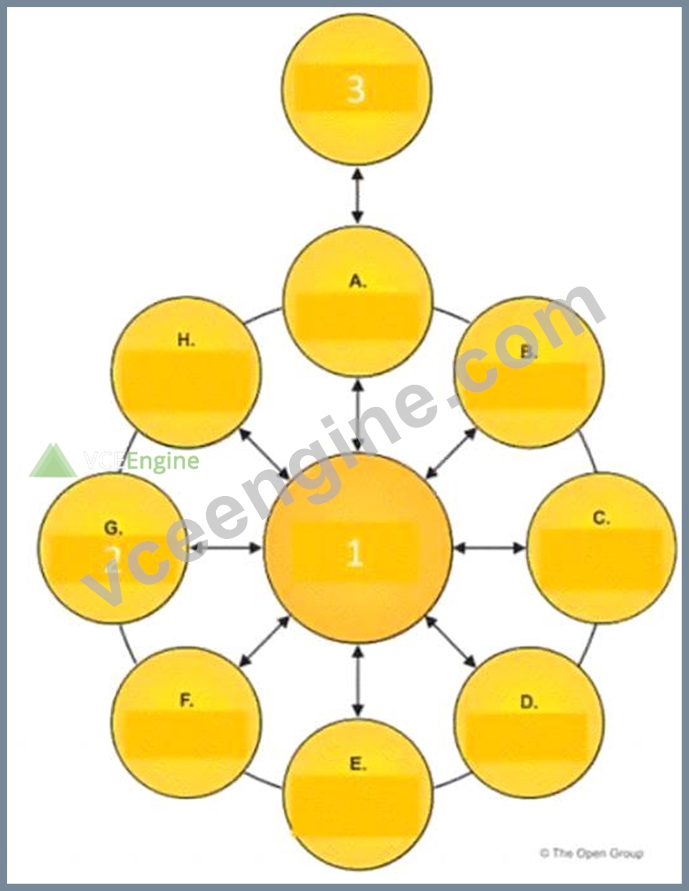
Consider the illustration showing an architecture development cycle Which description matches the phase of the ADM labeled as item 2?
- A. Conducts implementation planning for the architecture defined in previous phases
- B. Operates the process of managing architecture requirements
- C. Provides architectural oversight for the implementation
- D. Establishes procedures for managing change to the new architecture
Answer: C
Explanation:
Explanation
Based on the illustration, the phase of the ADM labeled as item 2 is the Implementation Governance phase.
This phase provides architectural oversight for the implementation. It ensures that the implementation project conforms to the architecture. It also provides a framework for monitoring and managing the implementation.
The Implementation Governance phase involves the following activities:
Finalizing the Architecture Roadmap and the supporting Implementation and Migration Plan Assigning an Architecture Board to oversee the implementation Establishing Architecture Contracts with the implementation partners Reviewing and approving the implementation project plans and deliverables Performing Architecture Compliance reviews to ensure alignment with the architecture Performing Architecture Audit reviews to ensure quality and performance of the architecture Resolving any architecture issues or change requests that arise during the implementation Maintaining the architecture lifecycle and ensuring its continuity The Implementation Governance phase is essential for ensuring that the architecture is realized as intended and that it delivers the expected business value and outcomes.
References: : Implementation Governance
NEW QUESTION # 122
Consider the following statements:
1. Each contracted party is required to act responsibly to the organization and its stakeholders.
2. All decisions taken, processes used, and their implementation will not be allowed to create unfair advantage to any one particular party.
3. Digital Transformation and operations will be more effective and efficient.
4. Strategic decision-making by C-Level executives and business leaders will be more effective.
Which statements highlight the value and necessity for Architecture Governance to be adopted within organizations?
- A. 1 & 4
- B. 3 & 4
- C. 2 & 3
- D. 1 & 2
Answer: D
Explanation:
Architecture governance is the practice of ensuring compliance with the enterprise architecture and its principles, standards, and goals. Architecture governance provides the means to establish, monitor, and control the architecture development and implementation processes, and to resolve any issues or conflicts that may arise. Architecture governance also ensures that all stakeholders are represented and involved in the decision-making process, and that their interests and concerns are balanced and aligned. Statements 1 and 2 highlight the value and necessity for architecture governance to be adopted within organizations, as they emphasize the importance of responsibility, accountability, fairness, and transparency in the architectural activities. Statements 3 and 4 are more related to the benefits and outcomes of having a good enterprise architecture, rather than the governance aspect.
Reference: : The TOGAF Standard, Version 9.2, Part VI: Architecture Capability Framework, Chapter 50: Architecture Governance : The TOGAF Standard, Version 9.2, Part III: ADM Guidelines and Techniques, Chapter 29: Architecture Governance
NEW QUESTION # 123
What is the purpose of the Preliminary Phase?
- A. Defining the Enterprise Strategy.
- B. Identifying the stakeholders and their requirements.
- C. Describing the target architecture.
- D. Developing an Enterprise Architecture Capability.
Answer: D
Explanation:
An Enterprise Architecture Capability is the ability of the organization to perform effective and efficient architecture work, including the definition, governance, and management of its architectures2. The Preliminary Phase involves the following activities1:
* Reviewing the organizational context, scope, and drivers for conducting Enterprise Architecture
* Establishing the Architecture Capability desired by the organization, including the maturity level, roles, responsibilities, processes, and tools
* Defining and establishing the Organizational Model for Enterprise Architecture, which describes how the architecture function is organized and integrated within the enterprise
* Defining and establishing the Architecture Governance framework, which provides the mechanisms for ensuring the quality, consistency, and compliance of the architecture work
* Selecting and implementing the tools that support the Architecture Capability, such as repositories, modeling tools, and communication tools
* Defining the Architecture Principles that will guide and constrain the architecture work, based on the business principles, goals, and drivers of the organization
* Defining the Organization-Specific Architecture Framework, which is an adaptation of the generic TOGAF ADM to suit the specific requirements, standards, and practices of the organization The Preliminary Phase is essential for preparing the organization for the successful development and implementation of its architectures, as well as for ensuring the alignment of the architecture work with the business strategy and objectives1.
NEW QUESTION # 124
Consider the following statement.
Projects may cycle between ADM phases, in planned cycles covering multiple phases.
What does it illustrate?
- A. Requirements management
- B. Implementation governance
- C. Iteration
- D. Enterprise Architecture
Answer: C
Explanation:
The statement "Projects may cycle between ADM phases, in planned cycles covering multiple phases" illustrates the concept of iteration, which is the process of repeating the ADM phases or steps within a phase to refine the architecture outputs and address the changing requirements and stakeholder concerns. Iteration can occur at different levels of granularity and scope, such as within a single phase, across multiple phases, or across the entire ADM cycle. Iteration can also be applied to different architecture domains, such as business, data, application, and technology. Iteration is a key feature of the ADM that enables the development of architectures that are fit for purpose, adaptable, and responsive to change.
NEW QUESTION # 125
Consider the following statement.
According to the TOGAF standard, a governed approach of a particular deliverable will ensure adherence to the principles, standards, and requirements of the existing or developing architectures.
Which deliverable does this refer to?
- A. The Architecture Definition Document
- B. The Statement of Architecture Work
- C. An Architecture Contract
- D. The Architecture Vision
Answer: C
Explanation:
According to the TOGAF Standard, 10th Edition, an architecture contract is "a formal agreement between a service provider and a service consumer that defines the mutual commitments and expectations for the delivery of an architecture" 1. An architecture contract is a governed approach of a particular deliverable that will ensure adherence to the principles, standards, and requirements of the existing or developing architectures, as it specifies the roles, responsibilities, deliverables, quality criteria, and acceptance criteria for the architecture work 1. The other options are not correct, as they are not governed approaches of a particular deliverable, but rather different types of deliverables within the architecture development process. An architecture vision is "a high-level, aspirational view of the target architecture" 1. A statement of architecture work is "a document that defines the scope and approach that will be used to complete an architecture project" 1. An architecture definition document is "a document that describes the baseline and target architectures for one or more domains" 1. Reference: 1: TOGAF Standard, 10th Edition, Part I: Introduction, Chapter 3: Definitions.
NEW QUESTION # 126
Consider the following statements:
* The TOGAF ADM requires a partitioning model for architecture development
* Architectures are partitioned when different teams need to work on different elements of the architecture at the same time
* Partitions can be used to facilitate architecture re-use
Which statements about Architecture Partitioning are correct?
- A. 1 and 3
- B. 1 and 2
- C. 2 and 3
- D. 1, 2 and 3
Answer: C
NEW QUESTION # 127
Exhibit
Consider the illustration showing an architecture development cycle Which description matches the phase of the ADM labeled as item 1?
- A. Conducts implementation planning for the architecture defined in previous phases
- B. Operates the process of managing architecture requirements
- C. Establishes procedures for managing change to the new architecture
- D. Provides architectural oversight for the implementation
Answer: B
Explanation:
* The illustration shows an architecture development cycle based on the TOGAF ADM (Architecture Development Method), which is a method for developing and managing an enterprise architecture1.
* The ADM consists of nine phases, each with a specific purpose and output. The phases are1:
* Preliminary Phase: To prepare and initiate the architecture development cycle, including defining the architecture framework, principles, and governance.
* Phase A: Architecture Vision: To define the scope, vision, and stakeholders of the architecture initiative, and to obtain approval to proceed.
* Phase B: Business Architecture: To describe the baseline and target business architecture, and to identify the gaps between them.
* Phase C: Information Systems Architectures: To describe the baseline and target data and application architectures, and to identify the gaps between them.
* Phase D: Technology Architecture: To describe the baseline and target technology architecture, and to identify the gaps between them.
* Phase E: Opportunities and Solutions: To identify and evaluate the opportunities and solutions for implementing the target architecture, and to define the work packages and transition architectures.
* Phase F: Migration Planning: To finalize the implementation and migration plan, and to ensure alignment with the enterprise portfolio and project management.
* Phase G: Implementation Governance: To provide architecture oversight and guidance for the implementation projects, and to manage any architecture change requests.
* Phase H: Architecture Change Management: To monitor the changes in the business and technology environment, and to assess the impact and performance of the architecture.
* In addition to these phases, there is a central process called Requirements Management, which is labeled as item 1 in the illustration. This process operates throughout the ADM cycle, and its purpose is to manage the architecture requirements throughout the architecture development, ensuring that they are aligned with the business requirements and the stakeholder concerns2.
* Therefore, the description that matches the phase of the ADM labeled as item 1 is C. Operates the process of managing architecture requirements.
References:
* 1: The TOGAF Standard, Version 9.2, Chapter 5: Architecture Development Method (ADM)
* 2: The TOGAF Standard, Version 9.2, Chapter 17: Requirements Management
NEW QUESTION # 128
Which of the following statements about architecture partitioning is correct?
- A. Partitions reflect the organization's structure.
- B. Partitions are defined and assigned to agile Enterprise Architecture teams.
- C. Partitions are used to simplify the management of the Enterprise Architecture.
- D. Partitions are equivalent to architecture levels.
Answer: C
Explanation:
Based on the web search results, architecture partitioning is a technique that divides the Enterprise Architecture into smaller and manageable segments or groups, based on various classification criteria, such as subject matter, time, maturity, volatility, etc.12 Architecture partitioning is used to simplify the development and management of the Enterprise Architecture, by reducing complexity, improving governance, enhancing reusability, and increasing alignment and agility12. Therefore, the statement that partitions are used to simplify the management of the Enterprise Architecture is correct.
The other statements are incorrect because:
* Partitions are not equivalent to architecture levels. Architecture levels are different layers of abstraction that describe the Enterprise Architecture from different perspectives, such as strategic, segment, and capability3. Partitions are subsets of architectures that are defined within or across the levels, based on specific criteria1.
* Partitions do not necessarily reflect the organization's structure. The organization's structure is one possible criterion for partitioning the architecture, but it is not the only one. Other criteria, such as business function, product, service, geography, etc., can also be used to partition the architecture12.
* Partitions are not defined and assigned to agile Enterprise Architecture teams. Agile Enterprise Architecture is an approach that applies agile principles and practices to the architecture work, such as iterative development, frequent feedback, adaptive planning, and continuous delivery4. Partitions are not a specific feature of agile Enterprise Architecture, but a general technique that can be applied to any architecture method or framework, including TOGAF12.
NEW QUESTION # 129
Please read this scenario prior to answering the question
You are the Lead Enterprise Architect at a major agribusiness company. The company's main annual harvest is lentils, a highly valued food grown worldwide. The lentil parasite, broomrape, has been an increasing concern for many years and is now becoming resistant to chemical controls. In addition, changes in climate favor the propagation and growth of the parasite. As a result, the parasite cannot realistically be exterminated, and it has become pandemic, with lentil yields falling globally.
The CEO appreciates the seriousness of the situation and has set out a change in direction that is effectively a new business for the company. There are opportunities for new products, and new markets. The company will use the fields for another harvest and will cease to process third-party lentils. Thus, the target market will change, and the end-products will be different and more varied. This is a major decision and the CEO has stated a desire to repurpose rather than replace so as to manage the risks and limit the costs.
The company has a mature Enterprise Architecture practice based in its headquarters and uses the TOGAF standard as the method and guiding framework. The practice has an established Architecture Capability, and uses iteration for architecture development. The CIO is the sponsor of the activity.
The CIO has assigned the Enterprise Architecture team to this activity. At this stage there is no shared vision, or requirements.
Refer to the scenario
You have been asked to propose the best approach for architecture development to realize the CEO's change in direction for the company.
Based on the TOGAF standard which of the following is the best answer?
- A. You propose that this engagement define the baseline Technology Architecture first in order to assess the current infrastructure capacity and capability for the company. Then the focus should be on transition planning and incremental architecture deployment.
This will identify requirements to ensure that the projects are sequenced in an optimal fashion so as to realize the change. - B. You propose that the team focus its iteration cycles on architecture development by going through the architecture definition phases (B-D) with a baseline first approach.This will support the change in direction as stated by the CEO. It will ensure that the change can be defined in a structured manner and address the requirements needed to realize the change.
- C. You propose that the team focus on architecture definition, with emphasis on defining the change parameters to support this new business strategy that the CEO has identified. Once understood, the team will be in the best position to identify the requirements, drivers, issues, and constraints for the change. You would ensure that the architecture development addresses non-functional requirements to assure that the target architecture is robust and secure.
- D. You propose that the priority is to understand and bring structure to the definition of the change. The team should focus iteration cycles on a baseline first approach to architecture development, and then transition planning. This will identify what needs to change in order to transition from the baseline to the target, and can be used to work out in detail what the shared vision is for the change.
Answer: D
Explanation:
Based on the TOGAF standard, this answer is the best approach for architecture development to realize the CEO's change in direction for the company. The reason is as follows:
* The scenario describes a major business transformation that requires a clear understanding of the current and future states of the enterprise, as well as the gaps and opportunities for change. Therefore, the priority is to understand and bring structure to the definition of the change, rather than focusing on the implementation details or the technology aspects.
* The team should use the TOGAF ADM as the method and guiding framework for architecture development, and adapt it to suit the specific needs and context of the enterprise. The team should also leverage the existing Architecture Capability and the Architecture Repository to reuse and integrate relevant architecture assets and resources.
* The team should focus iteration cycles on a baseline first approach to architecture development, which means starting with the definition of the Baseline Architecture in each domain (Business, Data, Application, and Technology), and then defining the Target Architecture in each domain. This will help to identify the current and desired states of the enterprise, and to perform a gap analysis to determine what needs to change in order to achieve the business goals and objectives.
* The team should then focus on transition planning, which involves identifying and prioritizing the work packages, projects, and activities that will deliver the change. The team should also create an Architecture Roadmap and an Implementation and Migration Plan that will guide the execution and governance of the change.
* The team should use the Architecture Vision phase and the Requirements Management phase to work out in detail what the shared vision is for the change, and to capture and validate the stakeholder requirements and expectations. The team should also use the Architecture Governance framework to ensure the quality, consistency, and compliance of the architecture work.
References: : The TOGAF Standard, Version 9.2 - Architecture Development Method : The TOGAF Standard, Version 9.2 - Architecture Vision : The TOGAF Standard, Version 9.2 - Requirements Management : [The TOGAF Standard, Version 9.2 - Architecture Governance]
NEW QUESTION # 130
Please read this scenario prior to answering the question
You are the Lead Enterprise Architect at a major agribusiness company. The company's main annual harvest is lentils, a highly valued food grown worldwide. The lentil parasite, broomrape, has been an increasing concern for many years and is now becoming resistant to chemical controls. In addition, changes in climate favor the propagation and growth of the parasite. As a result, the parasite cannot realistically be exterminated, and it has become pandemic, with lentil yields falling globally.
The CEO appreciates the seriousness of the situation and has set out a change in direction that is effectively a new business for the company. There are opportunities for new products, and new markets. The company will use the fields for another harvest and will cease to process third-party lentils. Thus, the target market will change, and the end-products will be different and more varied. This is a major decision and the CEO has stated a desire to repurpose rather than replace so as to manage the risks and limit the costs.
The company has a mature Enterprise Architecture practice based in its headquarters and uses the TOGAF standard as the method and guiding framework. The practice has an established Architecture Capability, and uses iteration for architecture development. The CIO is the sponsor of the activity.
The CIO has assigned the Enterprise Architecture team to this activity. At this stage there is no shared vision, or requirements.
Refer to the scenario
You have been asked to propose the best approach for architecture development to realize the CEO's change in direction for the company.
Based on the TOGAF standard which of the following is the best answer?
- A. You propose that this engagement define the baseline Technology Architecture first in order to assess the current infrastructure capacity and capability for the company. Then the focus should be on transition planning and incremental architecture deployment.
This will identify requirements to ensure that the projects are sequenced in an optimal fashion so as to realize the change. - B. You propose that the team focus its iteration cycles on architecture development by going through the architecture definition phases (B-D) with a baseline first approach.This will support the change in direction as stated by the CEO. It will ensure that the change can be defined in a structured manner and address the requirements needed to realize the change.
- C. You propose that the team focus on architecture definition, with emphasis on defining the change parameters to support this new business strategy that the CEO has identified. Once understood, the team will be in the best position to identify the requirements, drivers, issues, and constraints for the change. You would ensure that the architecture development addresses non-functional requirements to assure that the target architecture is robust and secure.
- D. You propose that the priority is to understand and bring structure to the definition of the change. The team should focus iteration cycles on a baseline first approach to architecture development, and then transition planning. This will identify what needs to change in order to transition from the baseline to the target, and can be used to work out in detail what the shared vision is for the change.
Answer: D
Explanation:
Based on the TOGAF standard, this answer is the best approach for architecture development to realize the CEO's change in direction for the company. The reason is as follows:
The scenario describes a major business transformation that requires a clear understanding of the current and future states of the enterprise, as well as the gaps and opportunities for change. Therefore, the priority is to understand and bring structure to the definition of the change, rather than focusing on the implementation details or the technology aspects.
The team should use the TOGAF ADM as the method and guiding framework for architecture development, and adapt it to suit the specific needs and context of the enterprise. The team should also leverage the existing Architecture Capability and the Architecture Repository to reuse and integrate relevant architecture assets and resources.
The team should focus iteration cycles on a baseline first approach to architecture development, which means starting with the definition of the Baseline Architecture in each domain (Business, Data, Application, and Technology), and then defining the Target Architecture in each domain. This will help to identify the current and desired states of the enterprise, and to perform a gap analysis to determine what needs to change in order to achieve the business goals and objectives.
The team should then focus on transition planning, which involves identifying and prioritizing the work packages, projects, and activities that will deliver the change. The team should also create an Architecture Roadmap and an Implementation and Migration Plan that will guide the execution and governance of the change.
The team should use the Architecture Vision phase and the Requirements Management phase to work out in detail what the shared vision is for the change, and to capture and validate the stakeholder requirements and expectations. The team should also use the Architecture Governance framework to ensure the quality, consistency, and compliance of the architecture work.
NEW QUESTION # 131
Please read this scenario prior to answering the question
You are employed as an Enterprise Architect within a clinical research and health technologies company. The company is dedicated to transforming healthcare with new ideas and advancements. The company has multiple divisions that cover different aspects of the business.
The company's Enterprise Architecture (EA) department has mature, well-developed architecture governance and development processes following the TOGAF standard.
In addition to the EA program, the company has a number of management
frameworks in use. The Architecture Board includes representatives from each division of the company. The Chief Information Officer (CIO) is the sponsor of the Enterprise Architecture program. The CIO has actively encouraged architecting with agility within the EA department as the preferred approach for projects.
Many of the company's rivals have begun using Artificial Intelligence (Al) in their operations, and the indications are that this will be transformative for healthcare delivery. This is something the EA department has been interested in for a while, and they had recently submitted an architecture Change Request which was approved. As a result, the CIO has approved a Request for Architecture Work to investigate the implementation of Al in the company.
Areas for evaluation include:
How can staff use Al daily in their current roles?
How can Al enhance access to care for patients, and how to make that experience seamless?
How can Al offer new workplace platforms and tools to increase efficiency?
Some of the top managers are worried about a change in the way of working, and if it will achieve the goals. Many are not confident that the company's risk management processes are adequate for a company-wide integration of generative Al. There are also questions from staff about whether enough specific guidelines and polices have been put in place for responsible use of Al.
Refer to the scenario
You have been assigned to the architecture development and asked how to address the concerns and manage risk for the project. How do you begin?
Based on the TOGAF standard which of the following is the best answer?
- A. You recommend that an analysis of the stakeholders is carried out. This will allow the architects to define groups of stakeholders who have common concerns and include development of a Stakeholder Map. The concerns and relevant views should then be defined for each group and recorded in the Architecture Vision document. To mitigate risk, you include a requirement that there be progressive development of the target architecture to ensure there is regular feedback.
- B. You recommend that all the stakeholders be identified, and a Communications Plan created to address the most powerful and influential stakeholders. This plan should include a report that summarizes the key features of the architecture with respect to each division and reflects the stakeholders' requirements. You will check with each key stakeholder that their concerns are being addressed. Risk mitigation should be explicitly addressed as a component of the architecture being developed.
- C. You recommend creation of a simple solution concept diagram to show how the stakeholders will be impacted, and the benefits to the firm. You would also create a benefits diagram showing the various opportunities from adoption of Al-based solutions. A meeting should be held with the main stakeholders to review the diagrams. They can then decide the priorities and sequencing decisions for the architecture development. Risk will be evaluated when defining the Architecture Roadmap.
- D. You recommend that models be created for the Draft Business, Data,Application, and Technology Architectures. These can be used to minimize risk, and make sure that the system meets the local regulations for each division.
Together with the problem description, and requirements, these should be included in the Architecture Vision document. A formal review should be held with the stakeholders to verify that their concerns are included in the Architecture Vision.
Answer: A
Explanation:
In this scenario you are right at the start of an ADM cycle: a Request for Architecture Work has been approved to investigate AI, and there are strong stakeholder concerns and risk questions. According to the TOGAF standard, the correct place to start is Phase A: Architecture Vision, with a strong focus on stakeholder management and capturing their concerns and required views.
Option A is the only answer that correctly reflects this:
Stakeholder analysis & Stakeholder Map (Phase A core task)
TOGAF explicitly states that in Phase A you must:
Identify stakeholders
Analyze and group them by common concerns
Use a Stakeholder Map to understand their influence, interest, and required engagement Determine which views/viewpoints are needed to address their concerns in the architecture description coe.qualiware.com+1 Option A says:
"analysis of the stakeholders ... define groups of stakeholders who have common concerns and include development of a Stakeholder Map. The concerns and relevant views should then be defined for each group and recorded in the Architecture Vision document." This is exactly how TOGAF describes stakeholder management and views in Phase A:
Stakeholder Map to classify and prioritize stakeholders
Concerns and required views captured and traced
These elements feeding into the Architecture Vision deliverable Visual Paradigm TOGAF+1 Concerns, views, and Architecture Vision TOGAF emphasizes that architecture views are constructed to address specific stakeholder concerns; you do not just build generic models. opengroup.org+1 Option A explicitly links concerns → views → Architecture Vision, which aligns with TOGAF guidance for early phases.
Capturing this in the Architecture Vision provides a high-level, shared understanding of what the AI initiative is trying to achieve and how stakeholder issues (e.g., responsible AI, risk processes, change in way of working) will be addressed.
Risk management and "architecting with agility"
In the scenario, the CIO has encouraged architecting with agility. TOGAF is compatible with incremental and iterative development of the target architecture, especially when there is high uncertainty and risk. conexiam.com Option A includes:
"a requirement that there be progressive development of the target architecture to ensure there is regular feedback." This "progressive development" and frequent feedback loop is exactly how you mitigate risk in an AI-heavy, change-sensitive initiative:
Frequent stakeholder feedback
Early validation of assumptions
Ability to adjust scope, constraints, and principles as risk and understanding evolve This directly addresses management's worry about the change in the way of working and whether risk management and responsible AI policies are adequate: these become explicit stakeholder concerns and requirements that are iteratively refined.
Why the other options are weaker / not TOGAF-aligned as a starting point Option B Focuses mainly on a Communications Plan and powerful stakeholders.
While TOGAF does expect a stakeholder communications plan, it is derived from a proper stakeholder analysis and Stakeholder Map, not a substitute for it.
It also treats risk as a "component of the architecture" rather than something to be addressed early through stakeholder concerns, principles, and iteration.
Option C
Jumps straight to a solution concept diagram and benefits diagram and defers risk evaluation to when the Architecture Roadmap is defined (Phase E).
In TOGAF, risk and stakeholder concerns must be addressed already in Phase A and refined throughout, not postponed to roadmap development.
Option D
Proposes creating draft Business, Data, Application, and Technology models and putting them into the Architecture Vision.
This is too detailed for the starting point: Phase A is about high-level vision, not full draft core architecture models (those belong in Phases B, C, D).
It also doesn't emphasize Stakeholder Mapping and grouping by concerns, which is central to resolving the worries about way of working, risk, and responsible AI.
In summary, Option A is the best and TOGAF-consistent way to begin:
Start in Phase A: Architecture Vision
Perform stakeholder analysis and create a Stakeholder Map
Define stakeholder concerns and relevant views
Record them in the Architecture Vision
Add an explicit requirement for progressive (iterative) development of the target architecture for continuous feedback and risk mitigation
NEW QUESTION # 132
Which of the following best describes the purpose of the Architecture Roadmap?
- A. It forms the basis of a contractual agreement between the sponsor and the architecture organization
- B. It lists work packages on a timeline showing progress towards the Target Architecture
- C. It is sent from the sponsor and triggers the start of an architecture development cycle
- D. It provides for effective communication of the end architecture project to the stakeholders
Answer: B
Explanation:
The purpose of the Architecture Roadmap is to provide a high-level view of how the Baseline Architecture will transition to the Target Architecture over time. It lists work packages on a timeline showing progress towards the Target Architecture, as well as dependencies, risks, and benefits. The Architecture Roadmap forms part of the Implementation and Migration Plan and guides the execution of the architecture projects.
References: https://pubs.opengroup.org/architecture/togaf9-doc/arch/chap20.html
NEW QUESTION # 133
Please read this scenario prior to answering the question
You are the Chief Enterprise Architect at a large food service company specializing in sales to trade and wholesale, for example, restaurants and other food retailers.
One of your company's competitors has launched a revolutionary product range and is running a very aggressive marketing campaign. Your company's resellers are successively announcing that they are not interested in your company's products and will sell your competitor's.
The CEO has stated there must be significant change to address the situation. He has made it clear that new markets must be found for the company's products, and that the business needs to pivot, and address the retail market as well as the existing wholesale market.
A consideration is the company's ability and willingness to change its business model, and if it is a temporary or permanent change. An additional risk factor is one of culture. The company has been used to a stable business with a reasonably well known and settled client base - all with its own local understandings and practices.
The CEO is the sponsor of the EA program within the company. You have been engaged with the sales, logistics, production, and marketing teams, enabling the architecture activity to start. An Architecture Vision, Architecture Principles, and Requirements have all been agreed. As you move forward to develop a possible Target Architecture you have identified that some of the key stakeholders' preferences are incompatible. The incompatibilities are focused primarily on time-to-market, cost savings, and the need to bring out a fully featured product range, but there are additional factors.
Refer to the scenario
You have been asked how you will address the incompatibilities between key stakeholder preferences.
Based on the TOGAF standard which of the following is the best answer?
- A. You recommend that since the CEO has stated that the company must pivot, it is better tocompromise on a full product range rather than time-to-market. You would develop just enough of theTarget Architecture to demonstrate fitness of the proposed approach. You would limit the descriptionto just where there is a gap between the current baseline. You would seek approval by thestakeholders to move forward with developing the Target Architecture in detail.
- B. You would review the Stakeholder Map and ensure that you have addressed and represented theconcerns of all department heads. You will involve them in resolving the incompatibilities.
TheCommunications Plan should include a report that summarizes the key features of the architecturewith and how incompatibilities were resolved to reflects the stakeholders' requirements.
You willcheck with each key stakeholder they are satisfied with how the incompatibilities have been resolved. - C. You would use the Architecture Vision, Principles, and Requirements to define a set of criteria foralternatives and create a set of architecture views to illustrate the impact of the alternative TargetArchitectures. You would identify the impact on planned projects. You would understand the strengthsand weaknesses of the alternatives. You would conduct a formal stakeholder review to decide whichalternative to move forward with. You will determine the funding required.
- D. You would seek to understand value preferences and priorities of the stakeholders. You woulddevelop alternative Target Architectures, highlighting the gaps between current state and thealternatives. You would consider combining features from one or more alternatives in collaborationwith the stakeholders.A formal stakeholder review should then be held to decidewhich alternative isfit for purpose and should be moved forward with. You will then secure the funding required.
Answer: C
Explanation:
According to the TOGAF standard, the Target Architecture is the description of a future state of the architecture being developed for an organization. It should be aligned with the Architecture Vision, Principles, and Requirements that have been agreed with the stakeholders. To address the incompatibilities between key stakeholder preferences, the TOGAF standard recommends creating and evaluating multiple alternative Target Architectures that meet different sets of criteria. These criteria should reflect the value preferences and priorities of the stakeholders, as well as the business drivers and objectives. The alternative Target Architectures should be illustrated using a set of architecture views that show the impact of each alternative on the business, data, application, and technology domains. The impact on planned projects should also be identified and analyzed. The strengths and weaknesses of each alternative should be understood and documented. A formal stakeholder review should then be conducted to decide which alternative is the most fit for purpose and should be moved forward with. The funding required for implementing the chosen alternative should also be determined and secured. References:
The TOGAF Standard, Version 9.2 - Phase B: Business Architecture - The Open Group The TOGAF Standard, Version 9.2 - Phase C: Information Systems Architectures - The Open Group
[The TOGAF Standard, Version 9.2 - Phase D: Technology Architecture - The Open Group]
[The TOGAF Standard, Version 9.2 - Phase E: Opportunities and Solutions - The Open Group]
[The TOGAF Standard, Version 9.2 - Phase F: Migration Planning - The Open Group]
NEW QUESTION # 134
Which of the following are the four purposes that typically frame the planning horizon, depth and breadth of an Architecture Project, and the contents of the EA Repository-?
- A. Avant-Garde Big-Bang, Discreet and Cohesive
- B. Segment, Capability. Enterprise and End-to-end Target Architecture
- C. General Foundational Subordinate and Superior Architecture
- D. Strategy Portfolio Project Solution Delivery
Answer: D
Explanation:
Explanation
Strategy Portfolio Project Solution Delivery are the four purposes that typically frame the planning horizon, depth and breadth of an Architecture Project, and the contents of the EA Repository. They correspond to different levels of abstraction and granularity in the architecture development process. Reference: The TOGAF Standard, Version 9.2 - The Open Group, Section 2.4 Architecture Repository.
NEW QUESTION # 135
Full Question:
Complete the sentence. The assets in the B and C are structured from generic to specific to provide a consistent language to ____________.
- A. B = Architecture Building Blocks, C = Solution Building Blocks, manage the volume of architectural content
- B. B = Business Architecture, C = Information Systems Solutions, define a taxonomy
- C. B = Architectures, C = Solutions, make it easier to understand conflicts
- D. B = Architecture Continuum, C = Solutions Continuum, communicate differences
Answer: D
Explanation:
In TOGAF, the Enterprise Continuum is divided into two major parts: the Architecture Continuum and the Solutions Continuum . These are used to classify architecture and solution assets from generic to specific. The Architecture Continuum organizes architecture assets such as foundation architectures, common systems architectures, industry architectures, and organization-specific architectures. The Solutions Continuum organizes corresponding solution assets, ranging from generic solutions through to organization- specific implementations.
The purpose of this structure is to provide a consistent language for describing and comparing architecture and solution assets. It helps architects communicate the differences between generic reusable guidance and specific enterprise solutions. This classification supports reuse, traceability, and consistency across architecture development.
The other options do not correctly identify the TOGAF concepts. Architecture Building Blocks and Solution Building Blocks are related concepts, but they are not the "B and C" referred to in the sentence. The correct pair is Architecture Continuum and Solutions Continuum .
Therefore, the correct answer is D .
NEW QUESTION # 136
Complete the sentence Business Transformation Readiness Assessment is_________________.
- A. a joint effort between corporate staff lines of business and IT planners
- B. a way to put building blocks into context thereby supporting re-usable solutions
- C. widely used to validate an architecture that is being developed
- D. to ensure the active support of powerful stakeholders
Answer: A
Explanation:
Business Transformation Readiness Assessment is a joint effort between corporate staff lines of business and IT planners to evaluate the readiness of the organization to undergo change. It involves assessing factors such as vision, commitment, capacity, capability, culture, and motivation that may influence the success of a business transformation initiative. Reference: The TOGAF Standard | The Open Group Website, Section
3.3.2 Business Transformation Readiness Assessment.
NEW QUESTION # 137
Which section of the TOGAF template for Architecture Principles should highlight the requirements for carrying out the principle?
- A. Implications
- B. Rationale
- C. Statement
- D. Name
Answer: A
Explanation:
The Implications section describes the impact of adhering to the principle on the organization, the processes, the information systems, and the technology23. It also identifies the changes, costs, and risks that may result from applying the principle23. The Implications section helps to communicate the benefits and consequences of the principle to the stakeholders and to guide the implementation and governance of the architecture23.
The other sections of the TOGAF template for Architecture Principles are1:
* Name: This section provides a short and memorable name for the principle that represents its essence and purpose23. The name should not mention any specific technology or solution23.
* Statement: This section provides a concise and formal definition of the principle that expresses the fundamental rule or constraint that the principle imposes23. The statement should be clear, unambiguous, and testable23.
* Rationale: This section provides the reasoning and justification for the principle, explaining why it is important and how it supports the business goals and drivers23. The rationale should also link the principle to the higher-level enterprise or IT principles that it elaborates on23.
NEW QUESTION # 138
......
The OGEA-103 certification exam comprises two parts, each with a different format. Part 1 is a closed-book exam that consists of 40 multiple-choice questions, and candidates have 60 minutes to complete it. Part 2 is an open-book exam that consists of eight scenario-based questions, and candidates have 90 minutes to complete it. The passing score for each part is 60%, and candidates must pass both parts to earn the certification.
Focus on OGEA-103 All-in-One Exam Guide For Quick Preparation: https://testking.vceengine.com/OGEA-103-vce-test-engine.html
